
10 AI Tools Every Full-Stack Developer Uses in 2026
From AI coding assistants to debugging platforms and autonomous developer agents, these are the AI tools full-stack developers are actually using in 2026 to build faster and ship smarter.
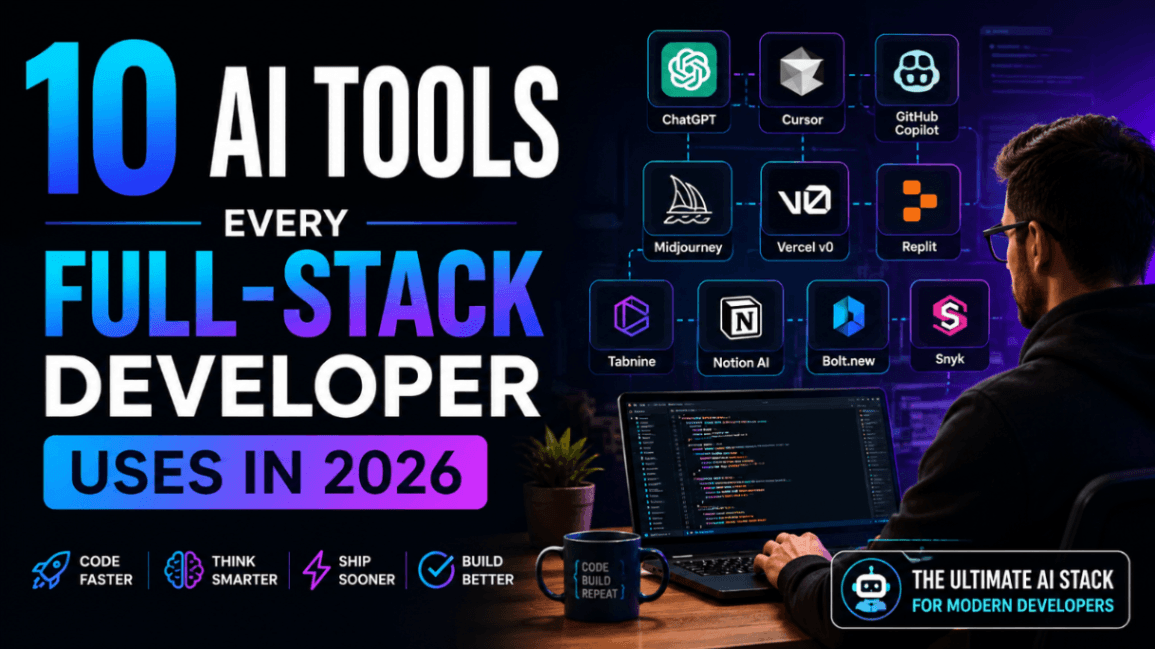
AI tools are no longer optional for developers in 2026.
From frontend generation to backend debugging, AI has become deeply integrated into modern software engineering workflows. Full-stack developers now rely on AI not just for writing code, but for planning architecture, fixing production issues, generating documentation, optimizing performance, and even shipping products faster.
The biggest shift is productivity. Developers using advanced AI workflows are building applications in days that previously took weeks.
But not every AI tool delivers real value.
Some are excellent for rapid prototyping. Others dominate debugging, reasoning, or large-scale engineering tasks.
Here are the 10 AI tools full-stack developers are actually using in 2026.
1. Claude
Claude has become one of the most trusted AI assistants for professional software engineering.
Its biggest strengths include:
- Large context understanding
- Advanced debugging
- Backend architecture planning
- Long-form reasoning
- Production-level code analysis
Developers use Claude heavily for APIs, databases, authentication systems, and large codebase refactoring.
For many engineering teams, Claude now acts like a senior developer assistant rather than a simple chatbot.
2. Cursor
Cursor completely changed how developers interact with IDEs.
Instead of constantly switching between code editors and AI chat windows, Cursor integrates AI directly into the coding workflow.
Popular features include:
- Inline AI editing
- Codebase-aware suggestions
- Natural language coding
- Fast refactoring
- AI-powered navigation
Many developers now consider Cursor one of the most important AI coding tools available.
3. Antigravity
Antigravity is becoming popular because of speed.
It performs extremely well for:
- React UI generation
- Landing pages
- Rapid MVP development
- Boilerplate code generation
- Fast prototyping
Developers who prioritize rapid execution often prefer Antigravity for frontend-heavy workflows.
Its aggressive generation style makes it especially useful for startups and fast-moving teams.
4. GitHub Copilot
GitHub Copilot remains one of the most widely adopted AI coding assistants in the world.
Integrated directly into development environments, it helps developers:
- Autocomplete code
- Generate functions
- Reduce repetitive coding
- Write tests faster
- Improve workflow efficiency
Even developers using newer AI tools still keep Copilot enabled for day-to-day productivity.
5. Windsurf
Windsurf is rapidly gaining attention among developers looking for deeper AI-native coding workflows.
It focuses heavily on:
- Multi-file understanding
- Context-aware editing
- AI-assisted engineering workflows
- Project-level reasoning
Many developers see Windsurf as part of the next generation of AI-native development environments.
6. Perplexity
Perplexity is becoming a surprisingly powerful developer research tool.
Instead of searching traditional forums manually, developers use Perplexity to:
- Research frameworks
- Compare technologies
- Understand APIs
- Summarize documentation
- Find debugging solutions quickly
Its citation-based answers make technical research significantly faster than traditional search engines.
7. Replit AI
Replit AI made browser-based development dramatically more powerful.
Developers use it for:
- Quick experiments
- Rapid deployments
- Learning new technologies
- Building prototypes online
- Collaborative coding
For beginners and indie developers, Replit AI remains one of the easiest ways to start building quickly.
8. v0 by Vercel
v0 became one of the most popular AI tools for frontend developers.
It can generate:
- Modern UI layouts
- React components
- Tailwind interfaces
- Dashboard designs
- Landing pages
Frontend developers use v0 heavily to accelerate design-to-code workflows.
9. Warp AI
Warp transformed the terminal experience by integrating AI directly into command-line workflows.
Developers use Warp AI to:
- Generate terminal commands
- Debug CLI errors
- Understand shell outputs
- Automate workflows
- Improve DevOps productivity
For backend engineers and DevOps teams, AI-powered terminals are becoming increasingly common.
10. AeoAudit
As AI search grows, developers are now optimizing websites for answer engines like ChatGPT, Gemini, Claude, and Perplexity.
AeoAudit helps developers and technical SEO teams analyze:
- AEO readiness
- Schema optimization
- AI citation visibility
- Entity signals
- Answer engine compatibility
For developers building AI-visible products, GEO and AEO optimization are becoming increasingly important.
⚔️ Quick Comparison Table
| Tool | Best For | Main Strength |
|---|---|---|
| Claude | Backend & reasoning | Deep engineering logic |
| Cursor | IDE workflows | AI-native coding |
| Antigravity | Frontend speed | Rapid generation |
| Copilot | Daily productivity | Inline suggestions |
| Windsurf | Multi-file workflows | Project-level AI context |
| Perplexity | Research | Citation-based answers |
| Replit AI | Rapid prototyping | Browser development |
| v0 | UI generation | Frontend acceleration |
| Warp AI | Terminal workflows | AI-powered CLI |
| AeoAudit | AI search optimization | AEO & GEO analysis |
🚀 The Future of AI Development
The biggest trend in 2026 is not replacing developers — it is amplifying them.
Developers using advanced AI workflows are shipping products faster, debugging smarter, and handling larger workloads with smaller teams.
AI coding assistants are evolving into full engineering copilots capable of understanding architecture, workflows, documentation, deployment, and business logic.
The developers who adapt early will have a massive productivity advantage over teams still relying entirely on traditional workflows.
🏆 Final Thoughts
No single AI tool dominates every development task.
The smartest developers in 2026 combine multiple AI tools together:
- Claude for reasoning and debugging
- Cursor for coding workflows
- Antigravity for rapid generation
- Perplexity for research
- v0 for frontend UI
The result is dramatically faster development cycles and significantly higher productivity.
AI is no longer a future developer tool.
It is already becoming the default development workflow.
❓ FAQ
What is the best AI coding tool in 2026?
Claude is currently one of the strongest overall tools for reasoning-heavy development, while Cursor and Antigravity dominate rapid coding workflows.
Which AI tool is best for frontend developers?
Antigravity and v0 are extremely popular for frontend UI generation and rapid React development.
Which AI assistant is best for backend engineering?
Claude performs best for APIs, databases, debugging, and backend architecture.
Are developers replacing IDEs with AI?
Not completely, but AI-native coding environments are becoming a major part of modern development workflows.
Do professional developers use multiple AI tools together?
Yes. Most advanced developers combine multiple AI tools depending on the workflow and task type.
Audit your content for AI Search.
Apply the strategies from this article automatically. Discover exactly how AI overviews see your website.
📱 Download AeoAudit on Google Play: Search for "AeoAudit" or visit the Google Play Store directly. Perfect for SEO professionals and website owners on the go.