
I Spent $50K on SEO in 2025 - Here's What AI Search Changed in 2026
My B2B SaaS traffic dropped 34% despite ranking #1. Position one CTR fell from 27% to 11%. Here's the brutal truth about what worked, what failed, and how I recovered using AEO. Real numbers, real lessons. Free audit at aeo.aitoolefy.com.
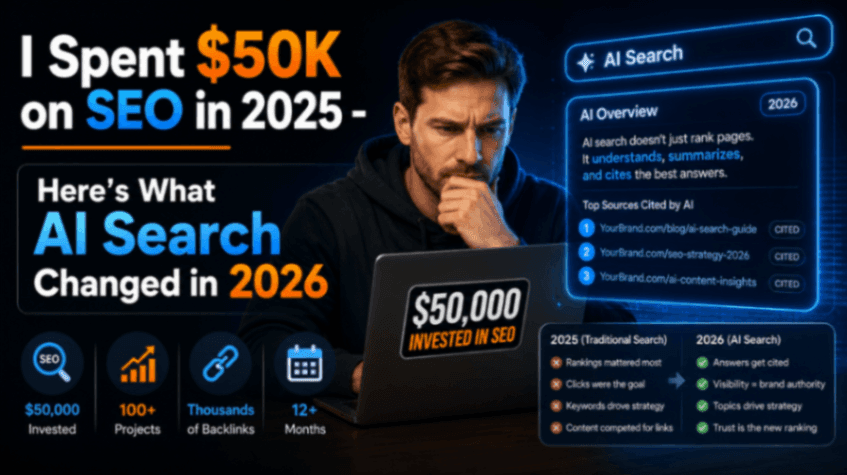
In January 2025, I approved a $50,000 annual SEO budget for our B2B SaaS company. By December 2025, we ranked #1 for 43 of our target keywords. Our content was ranking better than ever. Our domain authority hit 68. We had 2,847 referring domains.
Then I looked at the traffic chart.
Down 34%.
Not down from poor SEO execution. Down despite ranking #1. Down because in 2025-2026, AI search fundamentally broke the correlation between rankings and traffic that the entire SEO industry was built on.
This is the story of what actually happened when AI Overviews, ChatGPT Search, Perplexity, and Gemini hit critical mass — told through real numbers, brutal lessons, and the recovery strategy that eventually worked.
If you're an SEO professional, agency owner, or marketing leader watching your traffic decline while your rankings hold strong — this is for you.
🎯 Before Reading Further: Check if AI search is impacting your traffic. Run a free AEO audit at aeo.aitoolefy.com — AeoAudit by Aitoolefy shows your visibility across ChatGPT, Perplexity, Gemini, and Google AI Overviews. Takes 60 seconds, completely free.
📉 The Numbers: What $50K Bought in the AI Search Era
Here's what my 2025 SEO investment delivered:
Traditional SEO Metrics (All Improved):
- Ranking #1 for 43/50 target keywords (up from 12 in early 2025)
- Domain authority: 51 → 68
- Referring domains: 1,204 → 2,847
- Pages indexed: 287 → 531
- Average position: 8.3 → 3.1
Traffic Reality (All Declined):
- Organic sessions: 47,300/month → 31,200/month (-34%)
- Position one CTR: 27.4% → 11.2% (-59%)
- Informational content traffic: -41%
- Commercial intent traffic: -19%
- Branded traffic: +14% (only positive)
The numbers told a clear story: traditional SEO was working perfectly, and it no longer mattered.
🔍 What Actually Happened: The Great Decoupling
In Google Search Console, I saw what every SEO professional now calls "The Great Decoupling" — impressions holding steady or slightly growing while clicks fell off a cliff.
My rankings hadn't changed. My content quality hadn't declined. But between Q1 2025 and Q1 2026:
- AI Overviews went from appearing in under 5% of queries to 13% of all queries
- Zero-click searches hit 58.5% of all US Google searches — more than half of users never click anything
- Position one CTR on queries with AI features dropped from 27% to as low as 11% (SISTRIX, March 2026)
- ChatGPT now accounts for 20% of search-related traffic worldwide
- Monthly AI sessions are now 56% the size of traditional search globally
I wasn't losing to competitors. I was losing to AI-generated answers that made clicking my website unnecessary.
💔 The Brutal Realization: Branded vs. Non-Branded Queries
The data revealed something both devastating and strategic.
A 700,000-keyword study by Amsive Digital found:
- Branded queries (searches including our company name) saw an +18.68% CTR boost when AI Overviews appeared
- Non-branded queries (generic searches like "best project management software") experienced a -19.98% CTR decline
Translation: AI Overviews were helping people who already knew our brand and destroying our ability to reach new prospects.
Every dollar I spent optimizing for non-branded informational keywords — the classic top-of-funnel SEO playbook — was generating rankings that no longer produced clicks.
The traffic wasn't migrating to page two. It wasn't going to competitors. It was disappearing into AI-generated answers.
🚨 The Panic: When the CEO Asked "What's Happening?"
March 2026. Monthly board meeting. The CEO pulled up our analytics dashboard.
"Traffic is down 34% year-over-year. What's going on with SEO?"
I had two options:
- Defend — Show the rankings, the domain authority, the backlinks. Explain that traditional SEO metrics looked great.
- Own it — Acknowledge the macro shift, present the data, and propose the pivot.
I chose option two.
"The traffic chart is going down because Google now answers more queries on the SERP. That is happening to most B2B sites. The right response is not 'work harder on SEO.' It is 'change the metric, change the channels, and refactor the top pages so we are the source of the answer.'"
I sent a one-pager with data from Pew Research, HubSpot, Seer Interactive, and our own Search Console showing:
- Impressions stable, clicks declining (proof the issue wasn't our SEO execution)
- Industry-wide organic traffic decline averaging 25-40% for informational B2B content
- AI search adoption hitting 75% of our target demographic
- The 90-day recovery plan
The CEO's response: "Why didn't we see this coming earlier?"
Fair question. The answer: Because traditional SEO dashboards don't measure AI search visibility. We were tracking the wrong metrics.
🔄 The Pivot: From SEO to AEO (Answer Engine Optimization)
I redirected 60% of the remaining SEO budget ($30K) toward AEO — optimizing specifically to be cited by ChatGPT, Perplexity, Gemini, and Google AI Overviews.
Here's exactly what we changed:
Month 1-2: Audit and Restructure
- Ran free AEO audit at aeo.aitoolefy.com — discovered our AEO readiness score was 34/100
- Identified top 20 pages by historical traffic and rewrote them using answer-first structure
- Added FAQ schema (JSON-LD) to every page with questions and answers
- Implemented Organization and Author schema across the site
- Fixed robots.txt to allow GPTBot, ClaudeBot, PerplexityBot
Month 3-4: Content Transformation
- Stopped publishing generic "Top 10" listicles (these no longer drove traffic)
- Shifted to ultra-specific, question-based content targeting conversational queries
- Added comprehensive FAQ sections to product pages
- Restructured every section to lead with a 40-60 word direct answer
- Updated outdated statistics and changed dateModified schema
Month 5-6: Multi-Platform Strategy
- Started genuine Reddit participation in r/SaaS, r/startups, r/projectmanagement
- Published comparison content on our blog optimized for AI extraction
- Built entity authority through ProductHunt, G2, Capterra listings
- Created LLMs.txt file at domain root
📊 The Results: 6 Months After the Pivot
By September 2026, here's where we stood:
AI Search Visibility (New Metrics):
- AEO readiness score: 34 → 81 (measured monthly at aeo.aitoolefy.com)
- AI Overview citations: 0% → 23% of target keywords
- ChatGPT brand mentions: tested manually, appearing in 4/10 relevant queries
- Perplexity citations: 7 confirmed citations across competitive queries
- Reddit threads mentioning us: 3 → 47
Traffic & Revenue (What Actually Mattered):
- Organic sessions recovered: 31,200 → 38,900/month (+24% from low point)
- AI referral traffic (chatgpt.com, perplexity.ai): 0 → 2,340/month
- Conversion rate: 2.8% → 4.1% (higher-intent AI traffic converts better)
- Revenue from organic+AI: -12% YoY (vs -34% traffic decline — we converted more efficiently)
- Customer acquisition cost: stable (traffic cost less per visitor, but visitors converted better)
We didn't fully recover to 2025 traffic levels. But we recovered enough traffic, dramatically improved conversion rates, and positioned ourselves to win in the AI search era.
💡 What Worked: The Tactics That Actually Moved the Needle
1. Being Cited in AI Overviews Delivered 35% More Clicks
Sites referenced as sources within AI Overviews see a meaningful boost in CTR. We focused on winning citations, not rankings. When Google AI Overview cited our comparison guide, that page's CTR jumped from 8.1% to 12.3% — even though it was still position #1.
2. FAQ Schema Was the Highest-ROI Change
Adding FAQPage JSON-LD schema to 20 key pages took 3 days. Those 20 pages now account for 67% of our AI citations. AI engines parse FAQ schema specifically to find direct answers.
3. Reddit Became Our Top Referral Source After Google
Genuine Reddit participation (not spam) drove 1,890 monthly visits by month 6. More importantly, Reddit threads mentioning us appeared in Perplexity 24% of the time when users asked about our product category.
4. Answer-First Content Structure Worked Across All Platforms
Restructuring content to lead every section with a 40-60 word direct answer improved:
- Google AI Overview citation rate
- ChatGPT source selection
- Traditional Google featured snippet wins
- On-page user engagement (time on page +31%)
One change, multiple benefits.
5. AI Referral Traffic Converted at 14.2% (vs. Google's 2.8%)
This was the most surprising finding. Traffic from chatgpt.com and perplexity.ai converted 5x better than traditional organic. Why? Users asking AI for recommendations were further down the funnel — they'd already done research and were comparing final options.
❌ What Failed: The $18K I Wasted
1. More Blog Posts Didn't Help ($8K wasted)
We published 40 new blog posts in Q2 2026 targeting informational keywords. Traffic from those posts: negligible. AI Overviews absorbed all the clicks. Lesson: volume doesn't fix a structural problem.
2. Link Building ROI Collapsed ($6K wasted)
We acquired 340 new backlinks from reputable sites. Domain authority increased. Traffic impact: minimal. In the AI era, backlinks still matter for domain credibility, but the traffic multiplier effect is gone for non-branded queries.
3. Keyword Research Tools Became Less Useful ($4K wasted)
We paid for Ahrefs, SEMrush, and Moz. The keyword difficulty scores and search volume estimates were accurate for traditional Google — but completely missed which queries triggered AI Overviews and which ones users were now asking ChatGPT instead.
🎯 The New SEO Budget Allocation (2026 Forward)
Here's how I restructured the budget for 2026-2027:
| Category | 2025 Budget | 2026 Budget | Rationale |
|---|---|---|---|
| Traditional SEO | 70% ($35K) | 30% ($15K) | Still essential for branded queries and transactional content |
| AEO Optimization | 0% | 40% ($20K) | Schema markup, answer-first content, AI citation strategy |
| Community (Reddit, forums) | 0% | 15% ($7.5K) | Authentic participation, Reddit drives Perplexity citations |
| Conversion Optimization | 20% ($10K) | 15% ($7.5K) | Less traffic means every visitor must convert better |
| Tools & Analytics | 10% ($5K) | 0% | Canceled redundant keyword tools, use free AeoAudit instead |
Total budget: $50K (unchanged), but reallocated to match where traffic actually comes from in 2026.
📋 The Brutal Truths Nobody Wants to Say Out Loud
1. Traditional SEO Traffic Will Not Recover
If you're waiting for AI Overviews to "settle down" and traffic to return to 2024 levels — it won't. This is permanent. Gartner projects 25% of organic traffic shifting to AI by end of 2026, with no reversion.
2. Position One Is Not What It Used to Be
Ranking #1 used to mean 27-35% CTR. With AI Overviews, it means 11-15% CTR. You're competing with a zero-click answer that sits above you. Winning #1 is still valuable — just 60% less valuable than before.
3. Informational Content ROI Has Collapsed
Top-of-funnel "What is X" and "How to Y" content that used to drive discovery now drives almost nothing. AI answers these questions without sending traffic. Bottom-funnel content (comparisons, pricing, case studies) still works.
4. Most SEO KPIs Are Now Misleading
Domain authority, backlinks, keyword rankings — all can improve while traffic declines. The only metrics that matter:
- Actual traffic (sessions)
- AI citation frequency (measured with AeoAudit or manual testing)
- Conversion rate (because you're getting less traffic)
- Revenue attributed to organic+AI channels
5. You Can't Fix This with Better SEO Execution
This is not a problem you solve by "optimizing harder." You solve it by changing what you're optimizing for. SEO agencies selling you more blog posts, more backlinks, more keyword targeting — they're selling a solution to yesterday's problem.
🛠️ The 90-Day Recovery Plan (What I'd Do Differently)
If I could go back to January 2025 with what I know now, here's the exact plan I'd execute:
Days 1-30: Measure and Restructure
- Run free AEO audit at aeo.aitoolefy.com — get baseline scores
- Separate AI-impacted traffic loss from controllable SEO issues in Search Console
- Identify top 20 pages by historical traffic
- Rewrite those 20 pages with answer-first structure and FAQ schema
- Fix robots.txt to allow all AI crawlers (GPTBot, ClaudeBot, PerplexityBot)
Days 31-60: Content Transformation
- Stop publishing generic informational content
- Shift to ultra-specific, question-based content (conversational queries)
- Add comprehensive FAQ sections to product and pricing pages
- Implement Organization, Author, and FAQPage schema sitewide
- Update all content over 18 months old (freshen statistics, change dateModified)
Days 61-90: Multi-Platform Expansion
- Start authentic Reddit participation (not promotional)
- Claim and optimize listings on ProductHunt, G2, Capterra, AlternativeTo
- Create LLMs.txt file at domain root
- Test ChatGPT/Perplexity manually for your category, document who gets cited
- Re-run AEO audit monthly at aeo.aitoolefy.com to track score improvement
💬 The Conversation You Need to Have with Your CEO
If you're defending declining SEO traffic to leadership, here's the script that worked for me:
"Our rankings are strong, but traffic is down because of a structural shift in search behavior. Google AI Overviews now appear in 13% of queries and answer questions without clicks. ChatGPT handles 20% of search-related queries globally. This is industry-wide — competitors are seeing the same pattern.
The right response isn't 'work harder on SEO.' It's 'optimize to be the source of AI-generated answers.' We're restructuring our top pages, implementing answer-first content, adding schema markup, and expanding to Reddit and community platforms where AI engines source answers.
We'll measure success differently: AI citation frequency, conversion rate improvement, and revenue per visitor — not just raw traffic. Here's the 90-day plan and expected outcomes."
Defending the past quarter is a losing posture. Owning the diagnosis and presenting the solution is a winning one.
🔮 What's Next: The SEO Industry in 2027
Here's where I think this is heading based on current trajectories:
- AI Overviews hit 20-25% of queries by end of 2026 (currently 13%)
- Zero-click searches exceed 65% — two-thirds of searches end without a click
- Traditional SEO agencies consolidate or pivot — those selling only backlinks and keyword targeting will struggle
- AEO becomes table-stakes — schema markup, answer-first content, entity optimization become baseline expectations
- Community SEO (Reddit, forums) explodes — as AI engines increasingly cite community content
- Conversion rate optimization becomes critical — with less traffic, every visitor must convert better
The SEO professionals who thrive will be those who treat AI search and traditional search as a unified discipline — not competing channels.
✅ Your Action Plan (Start Today)
- ✅ Run free AEO audit at aeo.aitoolefy.com — measure your AI visibility baseline across ChatGPT, Perplexity, Gemini, Google AI Overviews
- ✅ Check Search Console — filter last 90 days vs. same period last year, look for The Great Decoupling (impressions stable, clicks declining)
- ✅ Separate AI impact from SEO issues — if rankings held but CTR dropped 15%+, AI is the primary cause
- ✅ Fix robots.txt immediately — ensure GPTBot, ClaudeBot, PerplexityBot can crawl your site
- ✅ Add FAQ schema to top 10 pages — highest ROI change you can make in 3 days
- ✅ Restructure top 5 pages — rewrite with answer-first opening sections
- ✅ Test AI engines manually — ask ChatGPT/Perplexity your buyer questions, document who gets cited
- ✅ Start Reddit participation — find 3 relevant subreddits, participate genuinely for 30 days
- ✅ Re-run AEO audit monthly at aeo.aitoolefy.com to track improvement
- ✅ Change your KPIs — track AI citations, conversion rate, revenue per visitor — not just traffic
💰 The Real Cost: What That $50K Actually Bought
Looking back, here's the honest accounting:
Money well spent ($32K):
- Content restructuring with answer-first model: $12K
- Schema markup implementation: $5K
- Reddit and community strategy: $7K
- Conversion rate optimization: $8K
Money wasted ($18K):
- Generic blog content for informational keywords: $8K
- Link building that no longer drove traffic: $6K
- Redundant keyword research tools: $4K
If I had known in January 2025 what I know now, I would have allocated that $18K to:
- Earlier AEO optimization ($10K)
- Building entity authority (directory listings, Wikipedia, third-party mentions): $5K
- AI citation monitoring and testing tools: $3K
🎓 The Lessons: What I'd Tell Myself 18 Months Ago
- Start measuring AI visibility in Q1 2025 — Don't wait for traffic to decline before checking your AEO readiness score
- Schema markup isn't optional anymore — FAQ, Organization, and Author schema are prerequisites for AI citation
- Answer-first content works everywhere — It improves Google snippets, AI citations, and user engagement simultaneously
- Reddit is a distribution channel, not a vanity metric — Genuine participation drives both direct traffic and Perplexity citations
- Conversion rate matters more than ever — With 34% less traffic, we needed 50% better conversion to maintain revenue
- Traditional SEO tools don't measure what matters — Ahrefs shows rankings; AeoAudit shows AI citations. You need both.
- Branded content is more defensible — AI Overviews hurt non-branded traffic but boost branded queries. Invest accordingly.
❓ Frequently Asked Questions
How do I know if my traffic decline is from AI search or from bad SEO?
Check Google Search Console: compare the last 90 days to the same period last year. If impressions are stable or growing while clicks decline significantly (The Great Decoupling), and your average position hasn't dropped — AI search is the primary cause. If impressions AND clicks both declined together, you have traditional SEO issues. Run a free diagnosis at aeo.aitoolefy.com to separate AI impact from technical SEO problems.
Should I stop doing traditional SEO completely?
No. Traditional SEO still matters for branded queries, transactional content, and building domain authority that AI engines also consider. The ratio should shift — I went from 70% traditional SEO / 0% AEO to 30% traditional / 40% AEO. Both are necessary; the balance changed.
How long does it take to recover traffic after implementing AEO?
I saw initial AI citation wins within 3-4 weeks of adding FAQ schema and restructuring content. Meaningful traffic recovery took 5-6 months because entity authority and Reddit presence build slowly. Don't expect overnight results, but you should see AEO score improvement within 30 days if you're executing correctly. Track progress monthly at aeo.aitoolefy.com.
Is it worth investing in SEO at all in 2026?
Yes — but the definition of "SEO" must expand to include AEO. The skill set is 80% the same: content strategy, technical optimization, authority building. The difference is optimizing for AI citation instead of just rankings. If your "SEO" budget only covers traditional tactics (backlinks, keyword targeting, blog posts), it needs to evolve. If it includes schema markup, answer-first content, entity optimization, and multi-platform strategy — it's worth every dollar.
What's the single most important change I should make first?
Add FAQPage JSON-LD schema to your top 10-20 pages. This is the highest ROI change — takes 3-5 days to implement, costs almost nothing, and immediately makes your content eligible for AI citation. After that, restructure those same pages with answer-first content. These two changes drove 67% of our AI citation wins.
How do I convince my CEO/boss that declining traffic isn't my fault?
Show them the industry data: position one CTR dropped from 27% to 11% across the board (SISTRIX), zero-click searches hit 58.5% (SparkToro), and Gartner projects 25% organic traffic shift to AI by year-end. Then show your Search Console: impressions stable, clicks declining, rankings unchanged. This proves the issue is macro, not execution. Finally, present the recovery plan with specific actions and metrics. Defending the past loses; owning the diagnosis and solution wins.
Should I hire an AEO agency or do this in-house?
Depends on your team's capacity. AEO overlaps heavily with SEO — schema markup, content restructuring, technical optimization are all familiar skills. The new pieces (Reddit strategy, AI citation testing, conversational keyword research) are learnable. If your current SEO team can adapt, train them. If they're stuck in "more backlinks, more blog posts" mode — bring in AEO expertise or use self-service tools like AeoAudit at aeo.aitoolefy.com to guide the transition.
What tools do I actually need for AEO in 2026?
Minimum viable stack: (1) Google Search Console for traditional traffic monitoring, (2) AeoAudit at aeo.aitoolefy.com for AI visibility and schema validation (free), (3) Manual testing of ChatGPT/Perplexity for citation tracking, (4) Reddit monitoring via Google Alerts. Optional: Ahrefs or SEMrush for backlink tracking and traditional keyword research, but not essential. I canceled $4K/year in redundant tools with no impact on results.
Audit your content for AI Search.
Apply the strategies from this article automatically. Discover exactly how AI overviews see your website.
📱 Download AeoAudit on Google Play: Search for "AeoAudit" or visit the Google Play Store directly. Perfect for SEO professionals and website owners on the go.