
AI in Cancer Detection 2026: How Machine Learning is Saving Lives
Google's AI detected 25% more breast cancers than radiologists across 115,973 mammograms. Harvard's CHIEF model achieved 94% accuracy across 19 cancer types. Discover how AI is revolutionizing cancer diagnosis in 2026.
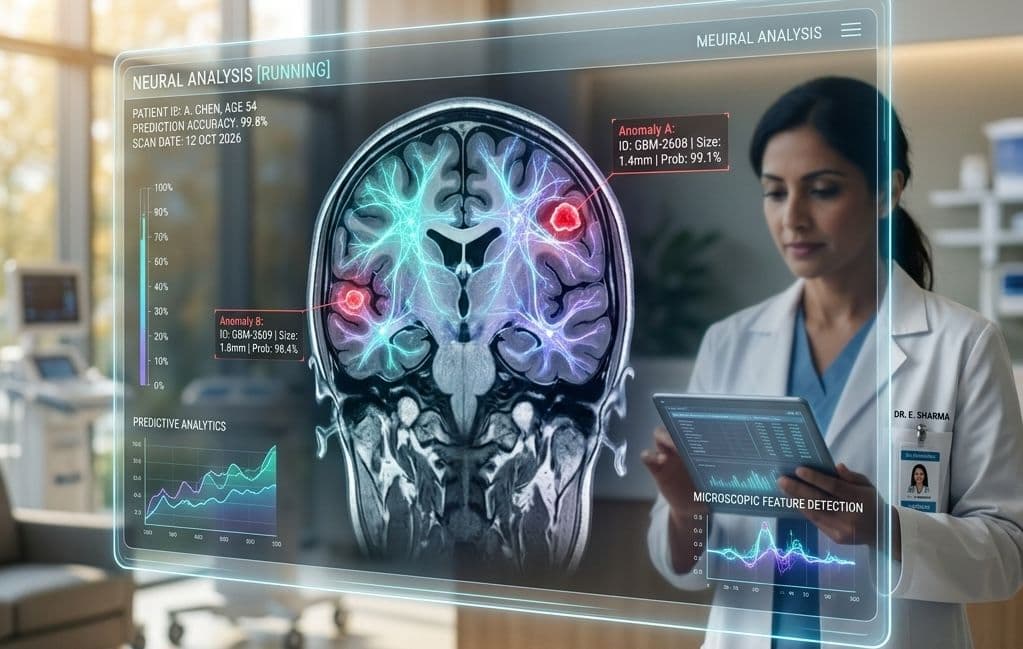
In April 2026, Google published results from the largest real-world deployment of AI in breast cancer screening to date. Across 115,973 mammograms from five UK National Health Service screening services, their AI system achieved something remarkable: it detected 25% of interval cancers — cancers that appeared between routine screenings and were completely missed by human radiologists.
The cancer detection rate increased from 7.54 to 9.33 per 1,000 women screened. That translates to nearly 200 additional cancers detected in this cohort alone — 200 women whose cancers were caught earlier because of AI, giving them significantly better survival odds.
This is not an isolated success story. At Harvard Medical School, researchers developed CHIEF — a ChatGPT-like AI model that achieved nearly 94% accuracy in cancer detection and significantly outperformed current AI approaches across 15 datasets containing 11 different cancer types.
We are witnessing a fundamental transformation in cancer diagnosis. AI is no longer experimental. It is operational, deployed, and saving lives today in 2026. This guide breaks down how it works, where it excels, where it struggles, and what it means for patients and clinicians.
🔬 How AI Detects Cancer: The Technical Foundation
AI cancer detection systems rely primarily on deep learning — a subset of machine learning characterized by multi-layer neural networks that autonomously learn hierarchical feature representations from raw data.
Unlike traditional computer algorithms that follow explicit rules programmed by humans, deep learning models learn patterns directly from millions of examples. A radiologist might describe suspicious features in a mammogram using terms like "spiculated mass" or "architectural distortion." An AI model learns what cancerous tissue looks like at a pixel level by analyzing tens of thousands of confirmed cancer cases and hundreds of thousands of normal scans.
The most common AI architectures used in cancer detection include:
- Convolutional Neural Networks (CNNs) — Specialized for image analysis, CNNs excel at detecting spatial patterns in medical imaging like CT scans, MRIs, mammograms, and pathology slides
- Support Vector Machines (SVMs) — Particularly effective for classification tasks, SVMs have achieved 97.13% accuracy in breast cancer prediction with AUC > 90%
- Vision Transformers — Newer architecture that processes images in patches, showing promise in whole-slide pathology analysis
- Ensemble Models — Combine multiple AI approaches to reduce individual model weaknesses and improve overall accuracy
🩺 Breast Cancer: Where AI Has Proven Most Effective
Breast cancer screening is where AI has achieved its most dramatic real-world impact in 2026.
The Google Health study published in Nature Cancer analyzed two phases: a retrospective analysis of 115,973 mammograms and a prospective feasibility deployment across 12 sites with 9,266 additional cases. The results were striking:
AI vs. First Reader (Radiologist):
- Sensitivity: AI 54.1% vs. Radiologist 43.7% (P < 0.001) — AI detected significantly more cancers
- Specificity: AI 94.3% vs. Radiologist 95.2% (P < 0.001) — AI maintained noninferior false positive rate
- Cancer detection rate: Increased from 7.54 to 9.33 per 1,000 women screened
- Interval cancer detection: AI caught 25% of cancers that appeared between screenings
Performance was particularly strong for:
- First screenings: 39.3% fewer recalls, 8.8% higher cancer detection
- Invasive cancers: AI excelled at detecting aggressive tumor types requiring urgent treatment
- Dense breast tissue: Where human interpretation is most challenging
These results represent the largest prospective evaluation of AI mammography screening to date and provide strong evidence for clinical implementation.
🫁 Lung Cancer: Early Detection Through AI Image Analysis
Lung cancer is the leading cause of cancer death globally, largely because it is typically detected late when treatment options are limited. AI is changing this trajectory through automated analysis of chest CT scans.
A 2023 systematic review analyzing machine learning AI architectures in lung cancer detection found:
- AI models consistently achieved high diagnostic accuracy in both detection and classification of lung nodules
- Deep learning approaches outperformed traditional computer-aided detection (CAD) systems
- AI showed particular strength in distinguishing benign nodules from malignant tumors — reducing unnecessary biopsies
- When integrated into clinical workflows, AI significantly reduced radiologist reading time while maintaining or improving accuracy
The challenge with lung cancer screening has always been false positives — benign nodules that look suspicious on CT but turn out to be harmless. AI dramatically reduces this problem by learning subtle texture and growth patterns that distinguish cancer from scar tissue, inflammation, or benign growths.
🧬 The CHIEF Model: Cancer's ChatGPT Moment
In late 2024, Harvard Medical School announced CHIEF — a versatile, foundation model for cancer diagnosis that represents the "ChatGPT moment" for oncology AI.
What makes CHIEF revolutionary is its generalist capability. Previous AI cancer models were specialists — trained for one specific task on one cancer type. A breast cancer detection model couldn't help with lung cancer. A tumor detection model couldn't predict treatment response.
CHIEF, by contrast, is trained to perform a wide array of diagnostic tasks across multiple cancer types — much like how ChatGPT can write code, answer questions, and summarize documents all in one model.
CHIEF's capabilities include:
- Detecting cancer presence across 19 different cancer types
- Predicting tumor genetic profiles from imaging alone
- Forecasting patient survival and treatment response
- Identifying biomarkers for precision therapy selection
- Classifying cancer subtypes with molecular precision
The model achieved nearly 94% accuracy in cancer detection and significantly outperformed current AI approaches across 15 datasets. Following training, the team tested CHIEF's performance on more than 19,400 whole-slide pathology images.
This "foundation model" approach represents a paradigm shift — instead of building 50 narrow AI tools for 50 specific tasks, oncology can now deploy one versatile system that handles the entire diagnostic workflow.
🎯 Beyond Imaging: AI in Liquid Biopsy and Biomarker Discovery
While medical imaging captures the spotlight, some of the most impactful AI work in 2026 is happening in areas invisible to traditional radiology.
Liquid Biopsy Analysis
Liquid biopsy — detecting cancer through blood tests rather than tissue biopsies — has been transformed by AI. Machine learning models analyze circulating tumor DNA (ctDNA), circulating tumor cells (CTCs), and cancer-associated proteins in blood samples to detect cancer earlier and with less invasive procedures.
AI advantages in liquid biopsy:
- Identifying ultra-low concentrations of tumor DNA that traditional analysis would miss
- Distinguishing cancer-associated mutations from normal aging-related changes
- Monitoring treatment response in real-time through serial blood draws
- Detecting cancer recurrence months before clinical symptoms or imaging changes appear
Histopathology and Biomarker Discovery
AI pathology analysis goes far beyond simply detecting cancer cells on slides. Modern systems can:
- Predict tumor molecular subtypes from H&E staining patterns alone — eliminating the need for expensive genetic testing in many cases
- Identify microsatellite instability (MSI) status — a critical biomarker for immunotherapy response
- Quantify tumor-infiltrating lymphocytes — predicting which patients will respond to immune checkpoint inhibitors
- Discover novel prognostic biomarkers by identifying visual patterns correlated with outcomes across thousands of cases
In oral squamous cell carcinoma, a three-stage deep learning model based on MRI achieved high accuracy in detecting lymph node metastasis in external validation cohorts and significantly reduced the rate of occult metastases — cancer spread that would have been missed by standard imaging interpretation.
🏥 Real-World Clinical Integration: How AI Fits into Workflow
The technical capability of AI is one thing. Integrating it into actual clinical practice is another. By 2026, several deployment models have emerged:
1. Concurrent Read (AI as Second Opinion)
Radiologist reads the scan first, then reviews AI's independent analysis. If human and AI disagree, the case goes to additional review. This model maintains physician autonomy while catching cases either party might miss.
2. AI Triage (AI Reads First)
AI analyzes all scans first, flagging high-suspicion cases for immediate radiologist review while marking normal scans as lower priority. This optimizes workflow in high-volume screening programs.
3. Replacement of Second Reader
In double-read mammography programs (standard in UK and many European countries), AI can replace the second human reader when both agree the scan is normal — saving significant radiologist time without compromising safety.
4. Decision Support (AI Provides Context)
AI doesn't make binary calls but provides quantitative risk scores, highlights suspicious regions, retrieves similar historical cases, and suggests differential diagnoses. The radiologist makes the final decision with enhanced information.
⚠️ Limitations and Challenges in 2026
Despite remarkable progress, AI cancer detection faces real limitations that must be acknowledged:
Training Data Bias
AI models are only as good as their training data. Most cancer AI systems have been trained predominantly on data from white populations in high-income countries. Performance can degrade significantly when deployed in different demographic groups or geographic regions.
Studies have found performance gaps of 5-15% in AI diagnostic accuracy across racial and ethnic groups when models are tested on underrepresented populations. This is not because cancer looks different biologically — it's because imaging characteristics, disease prevalence, and even scanner settings vary across populations.
Rare Cancer Types
AI excels where training data is abundant — breast cancer, lung cancer, skin cancer. For rare cancers affecting hundreds rather than millions of people, there simply isn't enough data to train robust models. CHIEF represents progress here, but the problem persists.
Explainability ("Black Box" Problem)
When a radiologist misses a cancer, we can usually identify why — overlapping tissue, unusual presentation, reader fatigue. When AI misses a cancer, we often cannot explain why the model failed. This "black box" nature makes it difficult to improve systems systematically and harder to establish trust.
Regulatory and Liability Questions
If AI recommends a biopsy that turns out unnecessary, who bears responsibility? If AI fails to flag a cancer that later progresses, is the radiologist liable for not overriding the AI, or is the AI vendor liable for the miss? These questions remain legally murky in 2026.
🔮 The Future: Predictive Oncology and Prevention
Current AI systems are diagnostic — they detect cancer once it exists. The next frontier is predictive and preventive oncology.
Emerging 2026 research is training AI on longitudinal datasets — years of imaging, lab work, and patient history preceding cancer diagnosis. The goal: identify pre-cancerous states and high-risk individuals years before tumors form.
Early results are promising:
- AI models analyzing serial mammograms can predict which women will develop breast cancer in the next 5 years with 70-75% accuracy
- Lung cancer prediction models using CT texture analysis can identify high-risk nodules that will become malignant years before standard growth-based criteria would trigger intervention
- Colorectal cancer AI analyzing colonoscopy videos can predict future cancer risk based on polyp characteristics and mucosal patterns
If validated at scale, this shift from detection to prediction could fundamentally change oncology — enabling targeted prevention in truly high-risk individuals rather than population-wide screening.
❓ Frequently Asked Questions
How accurate is AI at detecting cancer compared to human doctors?
Accuracy varies by cancer type and imaging modality. In breast cancer mammography, Google's 2026 study showed AI sensitivity of 54.1% vs. 43.7% for radiologists while maintaining similar specificity. For lung nodules, multiple studies show AI matching or exceeding radiologist accuracy. The Harvard CHIEF model achieved nearly 94% accuracy across 11 cancer types. However, AI performance depends heavily on the specific population, imaging protocol, and cancer prevalence in the dataset.
Can AI diagnose cancer without a doctor?
No. Current AI systems are diagnostic support tools, not replacements for physician judgment. They require medical oversight, integration into clinical workflows, and final decision-making by licensed clinicians. Regulatory agencies have not approved AI systems for autonomous cancer diagnosis without physician review.
What types of cancer can AI detect?
AI has been successfully applied to breast, lung, skin, prostate, colorectal, brain, liver, pancreatic, oral, cervical, ovarian, and blood cancers among others. The Harvard CHIEF model works across 19 cancer types. However, AI performance is strongest for cancers with large training datasets and well-defined imaging patterns. Rare cancers and cancers without characteristic imaging features remain challenging.
Does AI increase false positives and unnecessary biopsies?
Generally no. Well-designed AI systems maintain or reduce false positive rates compared to standard practice. The Google breast cancer AI achieved 94.3% specificity vs. 95.2% for radiologists — a clinically noninferior difference. However, poorly calibrated AI systems or inappropriate deployment can increase false positives, which is why rigorous validation in the target population is essential before clinical use.
Will AI replace radiologists and pathologists?
Not in the foreseeable future. AI augments rather than replaces human expertise. Radiology and pathology involve far more than pattern recognition — clinical correlation, communication with referring physicians, procedure guidance, and complex judgment calls that AI cannot handle. The likely future is human-AI teams where AI handles routine screening and quantification while physicians focus on complex cases and patient care.
How can I access AI-powered cancer screening?
Availability depends on your location and healthcare system. As of 2026, AI mammography is deployed in parts of the UK NHS, several US academic medical centers, and select private practices globally. For most patients, AI analysis happens behind the scenes — your mammogram or CT scan may be AI-analyzed without you being explicitly told. Ask your radiologist or oncologist whether AI is used in their practice and how it integrates into your care.
Are AI cancer detection tools approved by regulatory agencies?
Yes, multiple AI cancer detection systems have received FDA clearance in the United States and CE marking in Europe. However, approval status varies by specific tool, intended use, and cancer type. Google's mammography AI and several lung nodule detection systems have regulatory approval for clinical use. Always verify that any AI tool is properly approved for its intended clinical application.
Audit your content for AI Search.
Apply the strategies from this article automatically. Discover exactly how AI overviews see your website.
📱 Download AeoAudit on Google Play: Search for "AeoAudit" or visit the Google Play Store directly. Perfect for SEO professionals and website owners on the go.