
AI Search vs Google Search: Which Matters More in 2026?
Is Google still king, or have AI search engines like ChatGPT, Gemini, and Perplexity taken over? Discover what matters more for your website in 2026 — and how AeoAudit by Aitoolefy helps you win both.
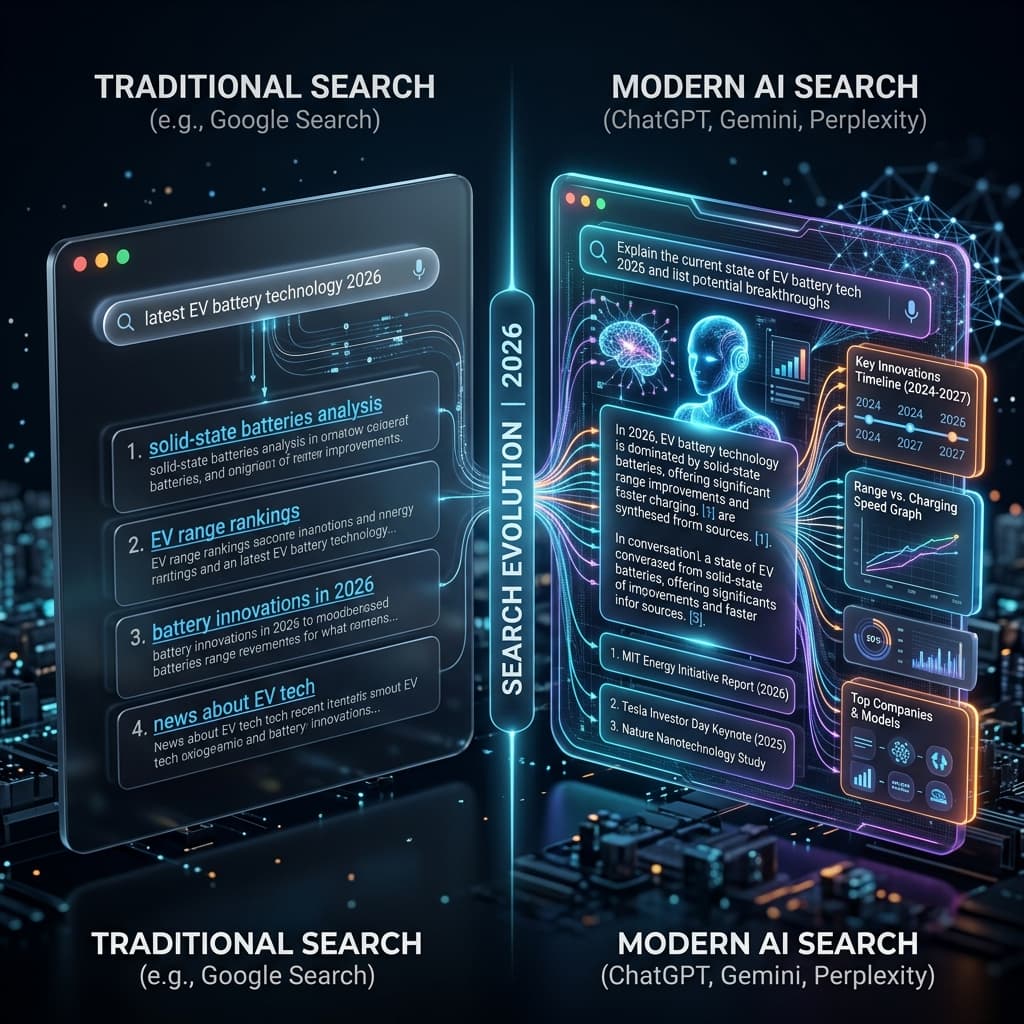
For nearly three decades, Google has been the undisputed king of search. Billions of people type queries into Google every single day — and entire industries have been built around ranking on its first page. But in 2026, a seismic shift is underway. AI search engines like ChatGPT, Gemini, and Perplexity are changing how people find information — and threatening Google's dominance like never before.
So the question every website owner, marketer, and SEO professional is asking: AI search or Google search — which one matters more? And more importantly, how do you optimize for both?
That's exactly what AeoAudit by Aitoolefy was built for. Let's break it all down.
🔑 Key Insight: In 2026, it's not AI search vs Google search — it's AI search and Google search. The winners are websites that optimize for both. AeoAudit at aeo.aitoolefy.com is the only free tool that audits your readiness for both worlds simultaneously.
📈 The Rise of AI Search Engines
The year 2023 marked a turning point. ChatGPT crossed 100 million users in just 60 days — the fastest-growing consumer application in history. By 2024, Google responded with AI Overviews (formerly SGE), embedding AI-generated summaries directly into search results. In 2025, Perplexity AI surpassed 15 million daily active users.
By 2026, the numbers tell a clear story:
- 40%+ of search queries are now answered directly by AI — without any link being clicked.
- ChatGPT Search processes over 100 million queries per week globally.
- Google AI Overviews appear in over 60% of informational search results.
- Perplexity AI is the fastest-growing search alternative, loved by researchers and professionals.
- Gen Z users are 3x more likely to use AI tools than Google for research tasks.
This is not a future trend — it is happening right now. Websites that aren't prepared are already losing traffic.
🔍 How Google Search Works (Traditional SEO)
Google's traditional search engine uses a link-based ranking algorithm. The core principle — established with PageRank in 1998 — is that pages linked to by other authoritative pages are more trustworthy and relevant.
Traditional SEO (Search Engine Optimization) involves:
- Keyword research — finding what terms people search for and targeting them in content.
- On-page SEO — optimizing title tags, meta descriptions, headers, and content structure.
- Link building — acquiring backlinks from reputable websites to boost authority.
- Technical SEO — improving site speed, crawlability, mobile optimization, and Core Web Vitals.
- Content quality — publishing comprehensive, authoritative content that satisfies search intent.
Traditional SEO is far from dead. Google still processes 8.5 billion searches per day. For local businesses, e-commerce, and navigational queries, Google remains the dominant channel.
🤖 How AI Search Works (AEO & GEO)
AI search engines operate fundamentally differently from Google. Instead of returning a ranked list of links, they synthesize answers directly from web content — citing sources in the process. This requires a completely different optimization strategy.
Key signals AI search engines look for:
- Direct, factual answers — Content that clearly answers specific questions without burying the answer.
- Structured data (JSON-LD) — Schema markup that makes content machine-readable for AI parsers.
- Entity authority — How well your brand is established in knowledge graphs and AI training data.
- Semantic depth — Topical coverage demonstrating genuine expertise, not just keyword stuffing.
- Citation worthiness — Content widely referenced by other authoritative sources.
- Conversational match — Natural language alignment with how people ask questions in AI chat interfaces.
This is where AeoAudit by Aitoolefy comes in. Visit aeo.aitoolefy.com and run a free audit to see exactly how your website scores on all these AI search signals.
📊 AI Search vs Google: Direct Comparison
| Factor | Google Search (SEO) | AI Search (AEO/GEO) |
|---|---|---|
| Primary signal | Backlinks & PageRank | Content clarity & entity authority |
| Result format | Ranked list of links | Synthesized answer with citations |
| User behavior | Click through to websites | Get answer directly (zero-click) |
| Best audit tool | Google Search Console | AeoAudit by Aitoolefy |
| Key content format | Long-form keyword-rich articles | Q&A, structured, factual content |
| Schema importance | Moderate | Critical |
| Query type dominated | Navigational, transactional | Informational, conversational |
| Traffic model | Click-based visits | Citation-based brand awareness |
| Growth trend (2026) | Declining for info queries | Rapidly growing |
⚖️ Which Matters More — Google or AI Search?
Here's the honest answer: it depends on your query type, audience, and business model — but you cannot afford to ignore either.
Google Still Wins For:
- Local searches — "restaurants near me," "plumber in Lahore" — Google Maps and local SEO dominate.
- E-commerce — People buying products still mostly use Google Shopping.
- Navigational queries — Searching for a specific brand or website by name.
- High-volume informational content — Established blog content still drives massive Google traffic.
AI Search Wins For:
- Research and learning — Students and professionals increasingly use ChatGPT and Perplexity over Google.
- Complex multi-part questions — AI engines handle nuanced, conversational queries far better.
- Technical and professional queries — Developers and marketers heavily use AI search daily.
- Brand discovery — Being cited by AI engines is the new "ranking on page 1."
- Gen Z users — Younger audiences are adopting AI-first search habits rapidly.
🏆 Optimize for Both with AeoAudit
The smartest strategy in 2026 is a dual optimization approach — traditional SEO for Google combined with AEO and GEO optimization for AI search engines. High-quality, well-structured, authoritative content performs well in both worlds.
AeoAudit by Aitoolefy at aeo.aitoolefy.com is the only free tool that audits your site for AI search readiness while also covering the technical fundamentals that matter for Google.
🛠️ How to Optimize for Both Channels
1. Write Content That Answers Questions Directly
Both Google's featured snippets and AI search engines favor content that answers questions concisely and accurately. Use H2/H3 headings phrased as questions followed by clear, factual answers.
2. Implement Comprehensive Structured Data
JSON-LD schema markup is a moderate signal for Google but a critical signal for AI search engines. Add FAQPage, HowTo, Article, and Organization schemas to your key pages.
3. Build Genuine Topical Authority
Both Google's E-E-A-T guidelines and AI engine citation algorithms reward genuine subject matter expertise. Publish a cluster of deeply researched articles around your core topics.
4. Earn High-Quality Backlinks and Citations
Backlinks remain the backbone of Google SEO — but they also feed into AI search. Getting listed on ProductHunt, G2, Capterra, and industry directories helps both channels simultaneously.
5. Target Conversational Long-Tail Keywords
Instead of only targeting "AEO tool," also target phrases like "What is the best free AEO audit tool in 2026?" These natural language queries are exactly what AI engines are built to answer.
🔮 The Future of Search
Industry analysts predict that by 2028, AI search engines will handle over 60% of all informational queries globally. Google itself is transforming into an AI-first platform — its Gemini integration represents the largest product overhaul in the company's history.
The websites that will dominate the next decade are those building for this AI-first future today. Aitoolefy built AeoAudit precisely for this moment. Start your free audit at aeo.aitoolefy.com and find out exactly where your website stands.
❓ Frequently Asked Questions
Is Google search dying because of AI?
Google is not dying — it is transforming. Google itself is integrating AI deeply through Gemini and AI Overviews. However, traditional blue-link results are declining for informational queries. Websites must optimize for both using tools like AeoAudit by Aitoolefy.
What is the difference between AEO and SEO?
SEO targets Google's link-based ranking algorithm. AEO targets AI engines like ChatGPT, Gemini, and Perplexity to get your content cited in AI-generated answers. AeoAudit by Aitoolefy audits your website for both.
How does AeoAudit help with both Google and AI search?
AeoAudit at aeo.aitoolefy.com analyzes technical SEO health (page speed, mobile, schema), AEO readiness (content structure, entity authority), and GEO signals (semantic vector proximity, JSON-LD quality). It is the only free tool covering all three areas in one audit.
Which AI search engine is most important to optimize for?
In 2026, the three most important AI search platforms are Google AI Overviews (largest user base), ChatGPT Search (fastest growing), and Perplexity AI (highest engagement among professionals). AeoAudit checks your optimization against all three simultaneously.
Can I rank in AI search without good Google SEO?
It is possible but difficult. AI search engines tend to cite content that is already authoritative on the web — which correlates with traditional SEO metrics. The best strategy is to build both simultaneously. AeoAudit helps you identify which area needs attention first.
Audit your content for AI Search.
Apply the strategies from this article automatically. Discover exactly how AI overviews see your website.
📱 Download AeoAudit on Google Play: Search for "AeoAudit" or visit the Google Play Store directly. Perfect for SEO professionals and website owners on the go.