
Antigravity vs Claude: Which AI Is Better for Coding in 2026?
We tested Antigravity and Claude across frontend development, backend architecture, debugging, reasoning, large codebases, and real-world developer workflows. Here's the complete comparison developers need in 2026.
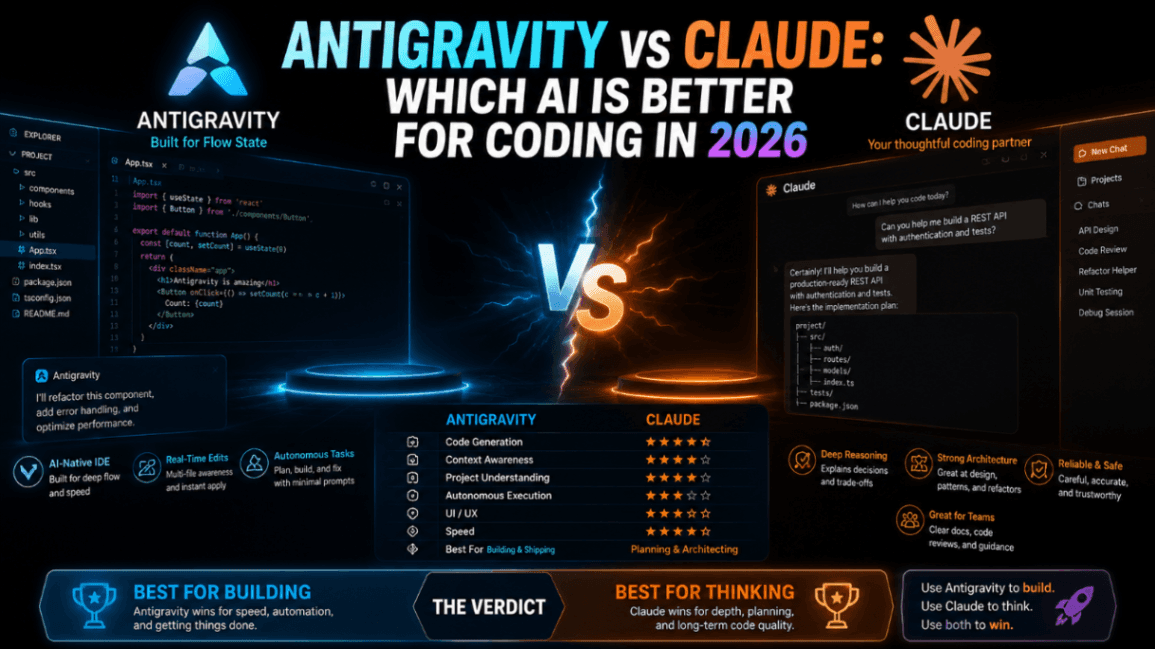
AI coding assistants are becoming essential for developers in 2026, and two tools are getting massive attention right now: Antigravity and Claude.
Both platforms can generate code, debug applications, explain logic, optimize workflows, and speed up development. But despite competing in the same category, they behave very differently in real-world coding environments.
Some developers prefer Antigravity because of its speed and aggressive code generation. Others rely on Claude for deeper reasoning, architecture planning, and production-level debugging.
So which one is actually better?
After testing both tools across frontend development, backend systems, debugging, large-context coding, and workflow efficiency, the answer becomes much clearer.
🚀 What Is Antigravity?
Antigravity is an AI platform optimized for rapid development workflows, fast iteration cycles, and aggressive productivity.
It is especially popular among developers building:
- React applications
- Landing pages
- Startup MVPs
- Automation tools
- Quick prototypes
- Frontend-heavy products
One reason developers like Antigravity is responsiveness. It often feels extremely fast when generating UI components, boilerplate code, and repetitive development tasks.
For developers working under tight deadlines, that speed becomes a major advantage.
🧠 What Is Claude?
Claude by Anthropic is one of the strongest reasoning-focused AI systems currently available.
Unlike tools optimized mainly for speed, Claude focuses heavily on:
- Logical reasoning
- Large-context understanding
- Code quality
- Architecture planning
- Long-form debugging
- Production reliability
Claude is widely used by professional developers working on complex backend systems, APIs, SaaS platforms, enterprise applications, and large codebases.
Its ability to understand long prompts and multiple files simultaneously makes it especially useful for advanced engineering work.
⚔️ Antigravity vs Claude: Quick Comparison
| Category | Antigravity | Claude |
|---|---|---|
| Code Generation Speed | Excellent | Very Good |
| Frontend Development | Excellent | Good |
| Backend Development | Moderate | Excellent |
| Reasoning Ability | Good | Excellent |
| Debugging Complex Issues | Good | Excellent |
| Large Codebase Handling | Average | Excellent |
| Context Window | Moderate | Very Large |
| Learning Support | Moderate | Excellent |
| Architecture Planning | Basic | Advanced |
| Rapid MVP Development | Excellent | Very Good |
🎯 Where Antigravity Performs Better
Antigravity shines in rapid execution environments where speed matters more than deep reasoning.
It performs especially well for:
- Generating React components quickly
- Creating landing pages
- Building startup MVPs
- Rapid feature iteration
- Frontend experimentation
- Boilerplate code generation
Many developers describe Antigravity as feeling more "aggressive" and workflow-oriented compared to traditional AI coding assistants.
It is particularly useful when developers already know what they want and simply need fast execution.
🔬 Where Claude Performs Better
Claude dominates in tasks that require deeper understanding and reasoning.
Its biggest strengths include:
- Complex backend architecture
- API design
- Database relationships
- Code refactoring
- Large-scale debugging
- Security analysis
- Long-context engineering workflows
Claude is also significantly better at understanding large codebases with multiple files and interconnected logic.
In production environments, this often matters more than raw generation speed.
💻 Frontend Development Comparison
For frontend workflows, Antigravity feels faster and more optimized for modern UI development.
Developers working with:
- React
- Next.js
- Tailwind CSS
- Landing page builders
- Component systems
often prefer Antigravity because it generates cleaner UI structures quickly.
Claude can still generate excellent frontend code, but its outputs tend to prioritize structure and maintainability over speed.
🛠️ Backend Development Comparison
This is where Claude clearly pulls ahead.
Claude performs significantly better for:
- Node.js backend systems
- Authentication flows
- API architecture
- Database optimization
- Microservices
- Error handling
- Complex business logic
It also explains backend logic more clearly, making debugging and optimization easier.
🐛 Debugging Comparison
Claude is currently one of the strongest AI tools for debugging.
It performs especially well at:
- Tracing logical issues
- Finding edge cases
- Understanding stack traces
- Explaining failures
- Suggesting optimized fixes
Antigravity can debug simpler problems effectively, but Claude generally handles advanced debugging scenarios much better.
📚 Which AI Is Better for Beginners?
For learning programming, Claude is usually the better choice.
Its explanations are more detailed, structured, and educational.
Beginners often struggle with AI tools that generate code without enough explanation. Claude reduces this problem by walking through logic step-by-step.
Antigravity is better suited for developers who already understand coding fundamentals and want maximum speed.
⚡ Speed vs Reasoning
The biggest difference between these tools is philosophy.
| Antigravity | Claude |
|---|---|
| Optimized for speed | Optimized for reasoning |
| Rapid generation | Deeper understanding |
| Workflow acceleration | Engineering reliability |
| Frontend-heavy | Backend-heavy |
| Fast iteration | Stable architecture |
One behaves like a rapid coding accelerator.
The other behaves more like a senior engineering assistant.
👨💻 Real Developer Workflow in 2026
Many professional developers now use both tools together instead of relying on a single AI assistant.
A common workflow looks like this:
- Use Antigravity for rapid UI generation and prototyping
- Use Claude for debugging, architecture review, and optimization
This hybrid workflow often produces the best balance between speed and reliability.
🏆 Final Verdict
Choose Antigravity if your priority is:
- Fast prototyping
- Rapid frontend development
- UI generation
- Quick iteration cycles
- Startup-style workflows
Choose Claude if your priority is:
- Complex engineering
- Backend systems
- Advanced debugging
- Architecture planning
- Production-level code quality
Right now, Claude remains the stronger overall AI coding assistant for professional engineering work.
However, Antigravity is rapidly becoming one of the most exciting tools for developers who prioritize speed and aggressive productivity.
❓ FAQ
Is Claude better than Antigravity for coding?
For complex development, debugging, and backend architecture, Claude is generally stronger.
Is Antigravity faster than Claude?
Yes. Antigravity usually feels faster during rapid code generation and frontend workflows.
Which AI is better for React development?
Antigravity performs extremely well for rapid React UI generation, while Claude is stronger for large-scale React architecture and maintainability.
Which AI is better for backend development?
Claude is significantly better for backend systems, APIs, databases, and complex business logic.
Can developers use both together?
Yes. Many developers combine Antigravity for speed with Claude for debugging and optimization.
Which AI is better for beginners?
Claude is usually better for learning because it explains concepts more clearly and provides deeper reasoning.
Audit your content for AI Search.
Apply the strategies from this article automatically. Discover exactly how AI overviews see your website.
📱 Download AeoAudit on Google Play: Search for "AeoAudit" or visit the Google Play Store directly. Perfect for SEO professionals and website owners on the go.