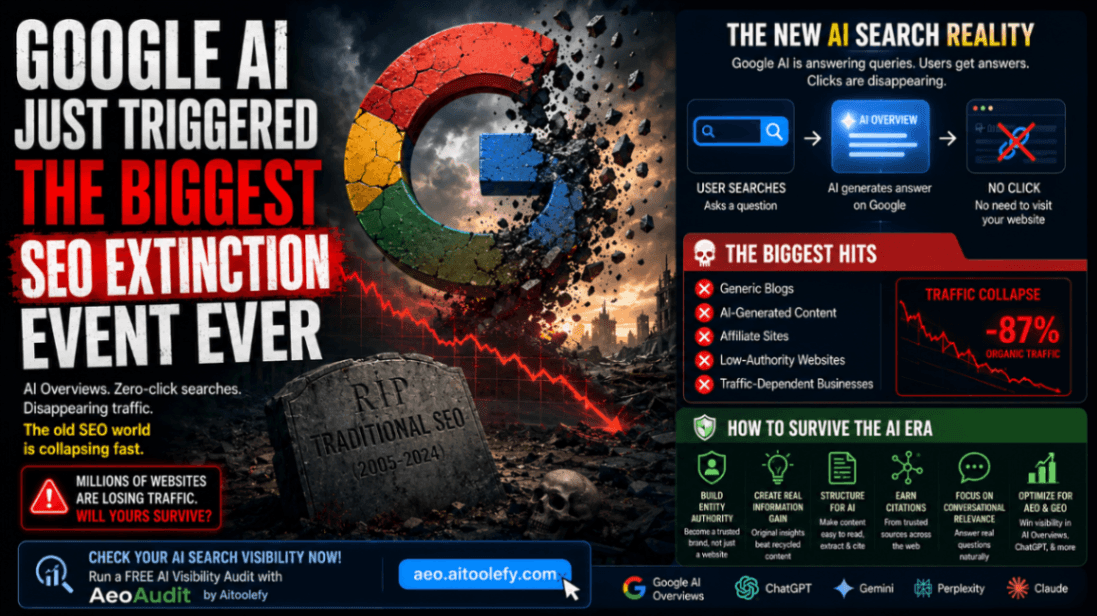
Google’s AI search rollout is no longer a small experiment.
It is rapidly becoming the largest disruption the SEO industry has faced in over two decades.
Millions of websites built entirely around informational content, affiliate traffic, display ads, and traditional organic rankings are suddenly losing visibility at a speed most experts never predicted.
The biggest problem?
Most websites still think this is just another Google update.
It is not.
This is a structural shift in how information is retrieved, summarized, and delivered across the internet.
🚨 Google AI Overviews Are Replacing Clicks With Answers
Traditional search worked like this:
- User searches
- Google shows links
- User clicks websites
- Websites monetize traffic
AI search changes the entire flow.
Google increasingly summarizes information directly, answers queries instantly, extracts content from multiple sources, and reduces the need to visit websites at all.
This is creating a massive rise in:
- Zero-click searches
- AI-generated answers
- Disappearing organic traffic
For many publishers, traffic losses have already started.
📉 The SEO Extinction Event Has Already Begun
The hardest-hit websites usually share the same patterns:
- Generic informational blogs
- Mass AI-generated articles
- Thin affiliate content
- Low-authority niche sites
- Websites built entirely on search traffic
These sites were designed for the old search economy.
AI search is creating a completely different ecosystem.
🧠 Why Google AI Changes SEO Forever
Google’s AI systems no longer rely only on keyword matching, backlinks, or page-level relevance.
Modern retrieval systems increasingly evaluate:
- Entity trust
- Semantic authority
- Information gain
- Citation quality
- Contextual relevance
- Source credibility
This means ranking #1 is no longer enough.
If AI systems can answer the query without sending traffic, traditional rankings lose value.
📊 Traditional SEO vs AI Search Reality
| Traditional SEO Era |
AI Search Era |
| Optimize pages |
Build trusted entities |
| Rank for keywords |
Become citation-worthy |
| Traffic from clicks |
Visibility inside AI answers |
| Backlink-heavy strategies |
Semantic authority systems |
| Content quantity wins |
Information gain wins |
| 10 blue links |
AI-generated summaries |
🔥 Why Most Websites Are Unprepared
Most SEO strategies still focus heavily on publishing more blogs, scaling AI content, backlinks, and keyword variations.
But AI systems increasingly prioritize:
- Trusted brands
- Authoritative entities
- Structured expertise
- Original insights
- Conversational relevance
This creates a brutal visibility divide.
A small trusted source can now outperform massive content farms.
🚀 AI Search Rewards Completely Different Signals
✅ Entity Authority
AI systems increasingly rank brands and people, not just webpages.
✅ Information Gain
Unique research and expert insights outperform rewritten content.
✅ AI Readability
Clear formatting improves AI extraction and citation probability.
✅ Cross-Platform Trust
Mentions across Reddit, LinkedIn, GitHub, YouTube, and media outlets strengthen authority.
✅ Conversational Relevance
AI systems prefer content aligned with natural human questions.
📉 Why Traffic Declines Are Accelerating
Many publishers are seeing:
- Lower click-through rates
- Reduced impressions
- Disappearing long-tail traffic
- Fewer organic conversions
The reason is simple:
AI answers increasingly satisfy user intent before clicks happen.
Google increasingly keeps users inside its own ecosystem.
⚠️ The Biggest SEO Mistake Right Now
Many websites are responding by generating even more AI articles, publishing faster, and chasing more keywords.
That strategy often makes the problem worse.
AI systems increasingly detect:
- Low originality
- Thin content
- Repetitive structures
- Weak expertise signals
Mass content alone no longer creates sustainable visibility.
🔍 The Future Belongs to AEO and GEO
The next evolution of SEO is:
- Answer Engine Optimization (AEO)
- Generative Engine Optimization (GEO)
This is no longer just about rankings.
It is about becoming trusted, retrievable, citation-worthy, and semantically authoritative.
Modern optimization now focuses on AI visibility, entity building, semantic relevance, and AI retrieval systems.
🛠️ What Smart Websites Are Doing Instead
- Building entity authority
- Publishing original research
- Structuring content for AI extraction
- Focusing on expertise
- Optimizing for AI citations
Winning visibility inside ChatGPT, Gemini, Claude, Perplexity, and Google AI Overviews is becoming the new SEO battlefield.
🔍 Check Your AI Search Visibility
Run a free AI visibility audit at aeo.aitoolefy.com.
AeoAudit by Aitoolefy helps analyze:
- AEO readiness
- GEO optimization
- AI citation structure
- Semantic SEO signals
- AI readability
- ChatGPT visibility
- Perplexity optimization
🔮 The Future of SEO After AI
The old SEO playbook is collapsing faster than most people realize.
The websites surviving the AI transition are not simply publishing more content.
They are building trust, authority, semantic depth, and AI retrievability.
The future winners will not just rank in search engines.
They will become the sources AI systems trust enough to cite.
Everyone else risks becoming invisible.
❓ FAQ
What is the SEO extinction event?
It refers to the massive decline in traditional organic traffic caused by AI-generated search answers and zero-click search experiences.
Are Google AI Overviews hurting websites?
Yes. Many publishers are already seeing reduced click-through rates and lower organic traffic.
Is traditional SEO dead?
No, but it is evolving rapidly toward AI search optimization, entity SEO, and semantic authority.
What is AEO?
Answer Engine Optimization focuses on optimizing content for AI-generated answers and retrieval systems.
What is GEO?
Generative Engine Optimization focuses on improving visibility inside AI systems like ChatGPT, Gemini, Perplexity, and Claude.
How can websites survive AI search changes?
By focusing on original insights, entity authority, semantic SEO, AI readability, and citation optimization.