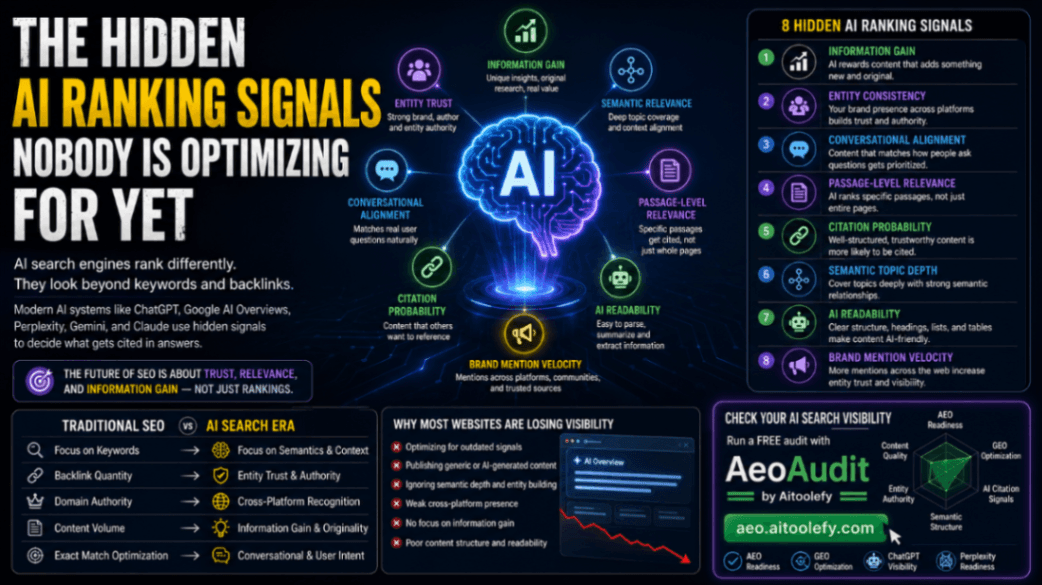
Most websites are still optimizing for outdated SEO signals.
They focus on keywords, backlinks, meta tags, content volume, and domain authority.
But AI search engines no longer rank content the same way traditional search engines did.
Modern AI retrieval systems like ChatGPT, Google AI Overviews, Perplexity, Gemini, and Claude increasingly rely on hidden ranking signals most websites completely ignore.
Some websites are consistently cited inside AI-generated answers while others are becoming invisible.
The difference often comes down to signals nobody is actively optimizing for yet.
🚨 Traditional SEO Signals Are Losing Influence
Traditional SEO still matters, but AI systems now evaluate deeper layers of trust, meaning, and contextual authority.
Instead of simply matching keywords, AI retrieval systems analyze:
- Entity relationships
- Semantic consistency
- Author trust
- Citation quality
- Information gain
- Cross-platform recognition
- User interaction patterns
This fundamentally changes ranking behavior.
🧠 AI Search Engines Rank Trust Architecture
One of the biggest misconceptions in SEO is believing rankings still revolve mostly around webpages.
Modern AI systems increasingly evaluate brands, authors, organizations, and topical ecosystems.
AI systems now ask:
- Is this entity trusted?
- Does this content provide unique information?
- Is the source recognized elsewhere online?
- Would another trusted source cite this?
This is why smaller niche websites sometimes outperform massive domains inside AI-generated answers.
📊 Traditional SEO vs Hidden AI Signals
| Traditional SEO |
Hidden AI Signals |
| Keyword density |
Semantic relevance |
| Backlink quantity |
Entity trust |
| Domain authority |
Cross-platform visibility |
| Content volume |
Information gain |
| Technical optimization |
AI readability |
🔥 Hidden AI Ranking Signals That Matter
1. Information Gain
AI systems increasingly reward content that adds something new instead of repeating existing information.
Original research, data studies, expert opinions, and real-world testing now outperform generic rewritten content.
2. Entity Consistency
AI systems validate brands across LinkedIn, Reddit, GitHub, YouTube, industry forums, and trusted media mentions.
Cross-platform recognition is becoming a major ranking factor.
3. Conversational Search Alignment
Users now search conversationally.
AI systems increasingly reward content that naturally answers real spoken questions instead of robotic keyword variations.
4. Passage-Level Ranking
AI systems rank paragraphs and passages, not only entire pages.
A single highly relevant section can appear inside AI-generated answers even if the overall page has low authority.
5. Citation Probability
AI systems increasingly evaluate whether a piece of content looks citation-worthy.
Content with clear structure, trustworthy data, external references, and expert insights performs better.
6. Semantic Topic Depth
Shallow keyword pages are losing visibility.
AI systems reward websites that deeply cover topics with strong semantic relationships and contextual depth.
7. AI Readability
Modern AI retrieval systems prefer content that is easy to parse, summarize, and extract.
Short paragraphs, headings, bullet points, FAQs, and structured formatting improve AI visibility.
8. Brand Mention Velocity
AI systems increasingly track how often brands are mentioned across discussions, communities, and trusted platforms.
Unlinked mentions now contribute to entity trust.
🚀 Why Most Websites Are Missing These Signals
Most SEO strategies are still optimized for old ranking systems focused heavily on backlinks and keyword density.
Meanwhile AI search is rapidly evolving toward trust, semantics, entities, contextual relevance, and citation quality.
This creates a massive visibility gap between modern AI-optimized brands and traditional SEO websites.
🔍 The Rise of AEO and GEO
This shift is why Answer Engine Optimization (AEO) and Generative Engine Optimization (GEO) are becoming critical.
The new challenge is no longer simply ranking webpages.
The real challenge is becoming the source AI systems trust enough to cite.
🛠️ How to Optimize for Hidden AI Signals
- Build strong entity presence across platforms
- Publish original research and insights
- Improve semantic relevance and topical depth
- Structure content for AI extraction
- Use FAQs, tables, and concise answers
- Focus on expertise and trust instead of mass publishing
🔍 Check Your AI Search Visibility
Run a free AI visibility audit at aeo.aitoolefy.com.
AeoAudit by Aitoolefy helps analyze:
- AEO readiness
- GEO optimization
- Semantic SEO signals
- AI readability
- ChatGPT visibility
- Perplexity citation readiness
🔮 Final Thoughts
The future of SEO is rapidly shifting away from traditional ranking signals.
AI systems increasingly reward:
- Trusted entities
- Semantic authority
- Original information
- Conversational relevance
- Citation-worthiness
- AI readability
The websites adapting early are already dominating AI-generated answers.
The rest are still optimizing for an internet that no longer exists.
❓ FAQ
What are hidden AI ranking signals?
These are modern ranking factors AI systems use, including semantic relevance, entity trust, citation quality, AI readability, and information gain.
Are backlinks still important?
Yes, but contextual trust and entity authority now matter far more than raw backlink quantity.
What is information gain?
Information gain measures whether content provides unique insights beyond what already exists online.
Why does entity SEO matter?
AI systems increasingly rank trusted entities like brands, authors, and organizations rather than only webpages.
How can websites improve AI visibility?
By focusing on semantic SEO, AEO, GEO, structured content, entity trust, and original research.