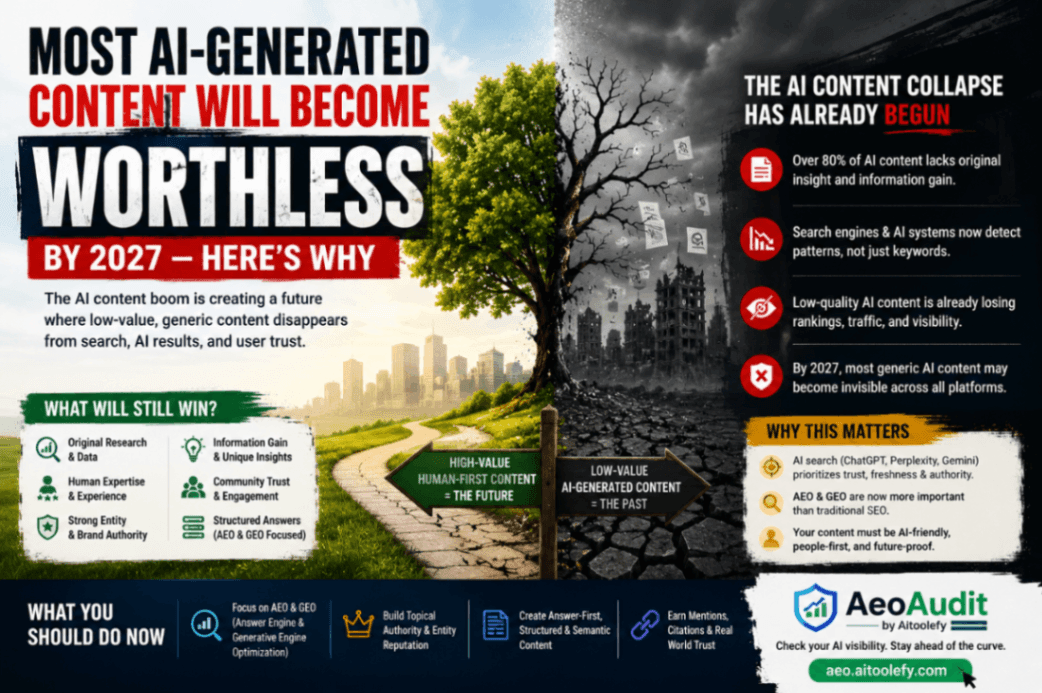
For the past two years, AI-generated content has exploded across the internet.
Millions of blogs, affiliate websites, landing pages, and SEO articles are now produced daily using ChatGPT, Claude, Gemini, and other generative AI systems.
At first, it looked like a content gold rush.
Cheap production. Massive scale. Unlimited publishing.
But behind the scenes, something much bigger is happening.
Search engines, AI answer engines, and retrieval systems are rapidly learning how to detect low-value AI-generated content patterns — and the websites depending entirely on mass AI publishing may be heading toward a major collapse by 2027.
🚨 The Internet Is Being Flooded Faster Than Search Engines Can Handle
The amount of AI-generated content online is now growing at a rate no traditional search system was built to process.
- Thousands of AI blogs get published daily
- Programmatic SEO pages multiply rapidly
- AI news summaries appear within minutes
- Generic listicles flood search indexes
Most of this content looks different on the surface, but structurally it often sounds the same.
That similarity is becoming a major problem for both Google and AI retrieval systems like ChatGPT, Perplexity, Gemini, and Claude.
⚠️ Why Most AI Content Feels Empty
AI models are trained on existing internet data. That means most generated articles become predictable rewrites of already existing ideas.
This creates what researchers now call content convergence.
The more AI-generated content appears online, the more similar the internet becomes.
And similarity is becoming toxic for modern AI search visibility.
📉 Google and AI Search Are Already Adapting
Modern search systems now evaluate:
- Topical authority
- Entity trust
- Semantic originality
- User engagement
- Information depth
- Source credibility
- Author expertise
- Behavioral signals
- Citation patterns
This is why many AI-generated websites experience sudden ranking instability, weak indexing, low engagement, and disappearing AI visibility.
🧠 AI Search Engines Want Trusted Sources
AI answer engines increasingly favor:
- Trusted brands
- Community discussions
- Expert authors
- Original research
- Fresh information
- High-authority entities
This explains why platforms like Reddit, GitHub, LinkedIn, and Stack Overflow are dominating AI-generated citations.
📊 Traditional SEO vs AI-Era Content
| Old SEO Content |
AI-Era High-Value Content |
| Keyword-heavy |
Intent-focused |
| Mass-produced articles |
Original insights |
| Thin affiliate pages |
Expert-driven analysis |
| Traffic-first |
Trust-first |
| Rewritten content |
Information gain |
| Generic AI wording |
Human expertise |
🚀 Why AEO and GEO Matter More Now
The future of search is moving toward Answer Engine Optimization (AEO) and Generative Engine Optimization (GEO).
Instead of optimizing only for rankings, websites must optimize for AI retrieval, AI citations, conversational search, semantic understanding, and voice-search-friendly answers.
🔍 The Biggest Weakness of AI Content Farms
Many AI content farms rely on:
- Automated publishing
- Minimal editing
- Repetitive structures
- Surface-level explanations
- Generic introductions
As AI retrieval systems improve, large portions of low-quality AI content may become effectively invisible.
📈 The Rise of Human Signal SEO
One of the biggest emerging trends is Human Signal SEO.
This includes:
- Real author identities
- Expert opinions
- Original experiences
- Industry recognition
- First-party data
- Cross-platform authority
AI systems increasingly trust content with strong human signals behind it.
⚙️ What Content Will Still Win by 2027?
- Original research
- Expert analysis
- Experience-based content
- Structured answer content
- Community-validated information
- Strong entity brands
🔥 Why Information Gain Is Becoming Critical
Search engines increasingly reward new information users cannot easily find elsewhere.
Generic AI-generated content often fails because it recombines existing ideas instead of adding real value.
🤖 AI Content Is Not Dead — But Lazy AI Content Is
AI itself is not the problem.
The future belongs to human-enhanced AI content with real expertise, better structure, stronger insights, and stronger trust signals.
🔍 Check Your AI Visibility Before Competitors Do
Run a free AI visibility audit using AeoAudit by Aitoolefy.
🔮 The Next Internet Will Reward Trust More Than Volume
The next generation of AI search systems will reward trust, originality, expertise, semantic uniqueness, and strong entities.
Most low-quality AI-generated content will slowly disappear from visibility systems — not because AI is banned, but because search systems are evolving beyond generic information.
❓ FAQ
Will Google ban AI-generated content?
No. Google primarily targets low-quality or spam-like content regardless of how it was created.
Why does AI-generated content often fail?
Because much of it lacks originality, trust signals, expertise, and information gain.
What is AEO?
AEO stands for Answer Engine Optimization.
What is GEO?
GEO stands for Generative Engine Optimization.
Can AI-written content still rank?
Yes, especially when combined with human expertise, strong structure, original insights, and entity authority.