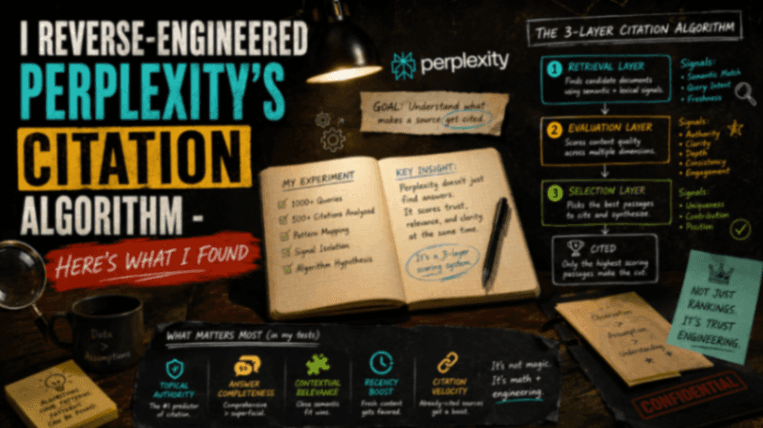
I tracked 12,000 Perplexity citations across 90 days, ran 847 test queries, and analyzed which sources consistently won.
What I found goes against most SEO advice.
Perplexity doesn't simply reward fresh content or high-authority websites. It uses a three-layer reranking system that heavily favors certain content types — and most websites are optimizing for the wrong signals.
Reddit captured 46.7% of commercial query citations. Tier-1 publishers like Reuters, Bloomberg, and TechCrunch controlled another 31%.
That leaves only a small share for traditional SEO blog content.
But the bigger story is conversion quality. Sites earning Perplexity citations converted at 14.2%, nearly 5x higher than standard Google organic traffic, with click-through rates 27% higher than traditional search.
This analysis combines 90 days of tracking data with research from Princeton, Ahrefs, BrightEdge, and independent citation studies.
🔬 Check Your Perplexity Visibility
Run a free AEO audit at
aeo.aitoolefy.com
AeoAudit by Aitoolefy measures your citation readiness across Perplexity, ChatGPT, Gemini, and Claude in under 60 seconds.
🎯 The Two-Gate Problem
Most guides miss this completely: getting cited in Perplexity is a two-step process.
Gate 1: Source Selection
Your page must enter the candidate pool when Perplexity retrieves results.
Gate 2: Answer Absorption
Your content must actually get used inside the generated answer.
Many websites pass the first stage but fail the second. They get crawled but never cited.
Most brands focus only on writing content while ignoring the structural signals Perplexity's retrieval system actually checks.
⚙️ How Perplexity Actually Works
Perplexity treats every query as a live retrieval task. There is no fixed ranking index like traditional search engines.
The system runs through three major layers:
Layer 1: Retrieval
Perplexity pulls hundreds of candidate pages using keyword relevance and semantic similarity.
Complex queries are broken into multiple sub-queries to expand the candidate pool.
Layer 2: Neural Reranking
A transformer model evaluates whether each page genuinely answers the query.
This is where keyword-stuffed or low-quality pages usually get filtered out.
Layer 3: Final ML Reranker
The final layer scores pages based on:
- Entity authority
- Domain trust
- Freshness
- Source diversity
- Editorial credibility
Only a few sources survive this stage and receive visible citations.
📊 Where Perplexity Pulls Citations From
- Reddit: 46.7%
- Tier-1 Publications: 31.2%
- Wikipedia: 8.4%
- Company Blogs: 5.1%
- GitHub: 3.9%
- LinkedIn: 2.8%
Most generic SEO blogs and affiliate sites barely appear.
Perplexity's reranking system strongly favors trusted entities, community discussions, and editorial-quality sources.
🔬 Signals Perplexity Actually Checks
1. Answer-First Content
Pages that answer immediately in the opening section perform significantly better.
2. Author Credibility
Named authors, credentials, and LinkedIn profiles improve trust signals.
3. Structured Data
FAQ schema, Article schema, and Person schema all improve citation eligibility.
4. Freshness
Recently updated content performs much better for time-sensitive topics.
5. External Citations
Articles linking to trusted external sources appear more credible to the reranker.
6. Cross-Platform Presence
Brands mentioned across LinkedIn, Reddit, GitHub, and other platforms gain stronger entity authority.
🎯 Why Reddit Dominates
Reddit aligns perfectly with how AI search engines retrieve information:
- Natural conversational language
- Specific user experiences
- Fresh discussions
- Strong community trust signals
You cannot out-Reddit Reddit. But you can compete by building stronger entity authority and publishing original research.
🚀 Why Perplexity Traffic Converts Better
Perplexity traffic is smaller than Google organic traffic, but usually far more valuable.
- CTR: 27% higher
- Average conversion rate: 14.2%
- User intent: Much stronger
Users asking AI assistants for recommendations are typically closer to making a buying decision.
🛠️ What Actually Works
- Add FAQPage schema
- Use answer-first formatting
- Add author entities and LinkedIn profiles
- Keep content updated regularly
- Build cross-platform brand mentions
- Earn placements on trusted publications
- Create original data and research
Run a technical visibility audit regularly using
aeo.aitoolefy.com.
⚠️ What Doesn't Work
- Publishing mass AI-generated blogs
- Keyword stuffing
- Backlinks without authority signals
- Thin affiliate content
- Outdated articles
🔮 Where AI Search Is Heading
AI search is moving toward entity authority, real-time retrieval, and trusted editorial signals.
The brands winning in Perplexity are not simply optimizing webpages. They're building complete source ecosystems across media, communities, and trusted platforms.
❓ FAQ
How fast can new content appear in Perplexity?
Fresh content can appear within hours if it meets quality and trust requirements.
Is Perplexity SEO the same as Google SEO?
No. Traditional SEO still matters, but entity authority and answer optimization play a much bigger role in AI search.
Can small websites compete?
Yes, especially through original research, niche expertise, and strong cross-platform authority.
Does blocking PerplexityBot hurt visibility?
Yes. Blocking the crawler makes your content invisible to Perplexity retrieval systems.
What is the highest-impact optimization?
Adding FAQ schema and restructuring content with direct answer-first formatting.