
Voice Search SEO & AI Assistants 2026: Complete Optimization Guide
Over 30% of searches are voice-based in 2026. Learn how to optimize for Siri, Alexa, Google Assistant, ChatGPT voice & AI Overviews. Complete guide with schema markup, conversational keywords & AEO strategies. Free audit at aeo.aitoolefy.com.
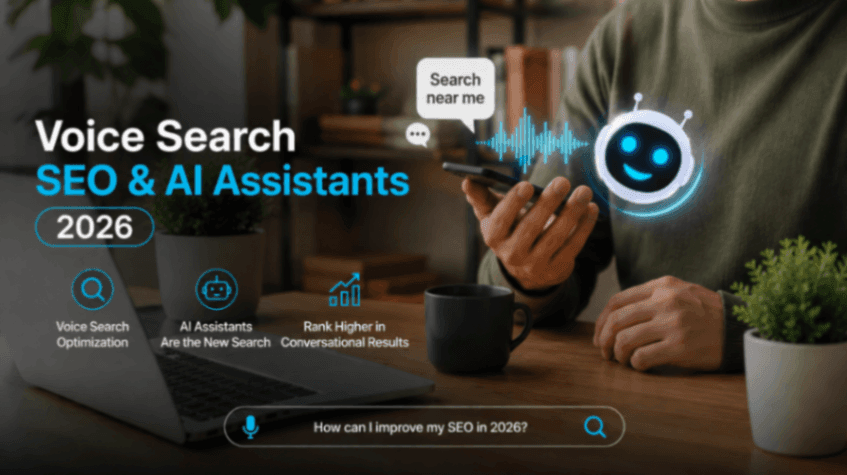
When someone asks their phone "Hey Google, what's the best AEO audit tool?" — will they hear your brand's name, or your competitor's?
In 2026, voice search accounts for over 30% of all searches globally, with 153.5 million Americans using voice assistants regularly and over 8.4 billion voice assistants in use worldwide — exceeding the entire global population. Voice commerce is projected to hit $100 billion globally by the end of 2026.
Here's what makes voice search fundamentally different from everything you know about SEO: voice assistants return a single answer. Not page one. Not top three. One answer. Second place in voice search is the same as not existing at all.
And in 2026, voice search and AI-powered answer engines have converged. Siri, Google Assistant, and Alexa now route voice queries through the same large language models that power their text-based AI search. ChatGPT has voice mode. Perplexity is launching voice. The distinction between "voice SEO" and "AI search optimization" has collapsed completely.
This is the most comprehensive guide to voice search optimization in 2026 — covering platform-specific strategies for Google Assistant, Alexa, Siri, and conversational AI, plus the exact technical optimizations that get you cited.
🎯 Before Optimizing: Know where you stand. Run a free AEO audit at aeo.aitoolefy.com — AeoAudit by Aitoolefy measures your voice search readiness across Google Assistant, Alexa, Siri, ChatGPT, Gemini, and Perplexity. Takes 60 seconds, completely free.
🎤 Why Voice Search Matters More Than Ever in 2026
Voice search is not a future trend. It's the present reality, and the numbers tell a clear story:
- Over 1 billion voice searches are performed monthly worldwide
- 27% of mobile users rely on voice search on their smartphones
- 65% of users aged 25-49 interact with voice-enabled devices at least once daily
- 75% of households in developed markets now own smart speakers
- Voice commerce is expected to exceed $100 billion globally by end of 2026
- Google Assistant accuracy now stands at 95%, with Alexa and Siri improving constantly through machine learning
But here's the critical insight most SEO guides miss: voice search optimization and Answer Engine Optimization (AEO) are now the same discipline. The strategies that make you the voice search answer also make you the AI answer.
When you optimize for voice, you simultaneously optimize for:
- Google AI Overviews (formerly SGE)
- ChatGPT's voice mode and search features
- Perplexity's conversational interface
- Claude's real-time search capabilities
- Gemini's integrated Google Assistant responses
The investment in one strengthens all the others.
🔍 How Voice Search Differs from Traditional SEO
Voice queries are fundamentally different from typed searches — and this difference requires a completely different optimization approach.
Query Structure
Typed search: "best project management software"
Voice search: "What's the best project management software for remote teams under $50 per month?"
Voice queries are:
- Conversational — Complete sentences, not keyword fragments
- Question-based — 70%+ of voice searches start with who, what, when, where, why, or how
- Longer — Average 3-5 words typed vs. 7-10 words spoken
- Local-intent heavy — "Near me" and location-based modifiers appear 3x more in voice
- Action-oriented — "Open now," "directions to," "call," "book"
Result Format
Traditional search: 10 blue links on page one
Voice search: Single spoken answer from position zero (featured snippet)
This changes everything. In traditional SEO, ranking #3 still drives traffic. In voice SEO, ranking #2 drives zero traffic — the voice assistant only reads the top result.
🤖 Platform-Specific Optimization: Google Assistant, Siri, Alexa
Each voice platform pulls from different data sources and uses different ranking signals. A multi-platform strategy is essential.
Google Assistant (95% accuracy, dominates Android)
Primary data sources: Google Search results, featured snippets, Google Business Profile, Knowledge Graph
Optimization priorities:
- Winning featured snippets (position zero in Google Search)
- Complete, verified Google Business Profile with Q&A, posts, and reviews
- FAQ schema markup on key pages
- Strong local SEO signals for "near me" queries
- E-E-A-T signals (Experience, Expertise, Authoritativeness, Trustworthiness)
Siri (Massive iOS user base, premium audience)
Primary data sources: Apple Maps, Yelp, various search partnerships, Google's Gemini AI (new 2026 integration)
Optimization priorities:
- Apple Business Connect listing (Apple's equivalent to Google Business Profile)
- Yelp profile optimization — Siri cites Yelp heavily for local recommendations
- High Yelp star rating (4.5+ ideal) with fresh reviews
- Accurate business information across Apple Maps
- Content optimized for Gemini AI (Siri's 2026 backend for complex queries)
Alexa (E-commerce focus, Bing integration)
Primary data sources: Bing search results, Amazon ecosystem, Yelp, Alexa Skills
Optimization priorities:
- Bing SEO (different algorithm than Google — prioritize exact-match domains, strong anchor text)
- Amazon presence if you sell products (Alexa heavily favors Amazon listings)
- Yelp and Facebook reviews (Bing incorporates both for local results)
- Alexa Skills development for branded interactions (if relevant)
- Schema markup that Bing can parse
Critical insight: Research found only 1% answer overlap across Google, Siri, and Alexa for identical queries. Google Home and Siri overlapped just 10%. This fragmentation means you must optimize for all three — dominating Google Assistant alone leaves 60%+ of voice search traffic on the table.
🗣️ Conversational Keyword Research for Voice SEO
Traditional keyword research tools like Ahrefs and SEMrush are built for typed searches. Voice search requires a different approach.
Question-Based Long-Tail Keywords
Voice searches are predominantly questions. Target these exact phrasing patterns:
- "What is the best [product/service] for [specific use case]?"
- "How do I [accomplish task] without [common obstacle]?"
- "Where can I find [product/service] near me that's [modifier]?"
- "Who is the [superlative] [profession] in [location]?"
- "When is the best time to [action] for [goal]?"
- "Why does [problem] happen and how do I fix it?"
Natural Language Modifiers
Voice users add conversational modifiers that typed searches omit:
- "Near me" / "close by" / "in my area"
- "Open now" / "open late" / "24 hours"
- "Best" / "top rated" / "most affordable" / "highest quality"
- "That accepts [payment method]" / "that offers [service feature]"
Local Voice Search Patterns (Critical for Service Businesses)
These are the exact phrases driving local voice traffic in 2026:
- "What [service] companies near me are open right now?"
- "Who is the best [profession] in [neighborhood/city] for [specific need]?"
- "Find me a [business type] that's open now and accepts [requirement]"
- "How much does [service] cost in [location]?"
- "[Business type] near me with the best reviews"
Create dedicated pages or FAQ sections answering each high-intent voice query pattern in your niche.
📐 Schema Markup for Voice Search: The Technical Foundation
Schema markup is not optional for voice search — it's a prerequisite for citation eligibility. Voice assistants cannot guess at content structure. You must explicitly tell them.
Priority Schema Types for Voice
1. FAQPage Schema (Highest impact)
FAQ schema tells voice assistants exactly which content is a question-answer pair, dramatically increasing citation likelihood.
Implementation: Add FAQPage JSON-LD to any page with Q&A content. Each question becomes eligible for voice citation.
2. SpeakableSpecification Schema (Voice-specific)
This schema explicitly marks sections of content designed for voice readout — telling assistants "this text is optimized for being read aloud."
Implementation: Add SpeakableSpecification to article sections with clean, natural-sounding prose ideal for voice delivery.
3. LocalBusiness Schema (Critical for "near me")
Local business schema with complete NAP (Name, Address, Phone), hours, service areas, and geo-coordinates is essential for local voice queries.
4. HowTo Schema (For instructional content)
Structured step-by-step instructions are ideal for voice delivery — HowTo schema makes them discoverable.
5. Organization Schema (For entity authority)
Organization schema with sameAs links to all your social profiles establishes your brand as a recognized entity across voice platforms.
After implementing schema, validate everything with a free GEO audit at aeo.aitoolefy.com/geo-audit-tool — AeoAudit automatically checks schema quality, completeness, and voice-readiness.
✍️ Content Structure for Voice Citation
Voice assistants extract answers from content following specific structural patterns. Your content must match these patterns to be cited.
The Answer-First Model (Non-Negotiable)
Voice assistants sample the opening of each section looking for direct answers. Bury your answer three paragraphs deep and you're invisible.
Structure every section:
- Direct answer in 40-60 words — First sentence = complete answer
- Supporting details — 3-5 factual bullet points or short paragraphs
- Concrete example — Real-world illustration grounding the answer
- Self-contained — Section must make complete sense without reading anything else
Question Headings (H2 and H3)
Phrase headings as natural questions exactly as users would ask voice assistants:
❌ Bad: "AEO Overview"
✅ Good: "What is AEO (Answer Engine Optimization)?"
❌ Bad: "Implementation Guide"
✅ Good: "How Do I Optimize My Website for Voice Search?"
Natural, Speakable Language
Voice assistants read your content aloud. If it sounds robotic or overly formal when spoken, it won't be selected.
Test: Read your content out loud. If it sounds unnatural, rewrite it. Contractions, conversational transitions, and first/second-person pronouns all improve speakability.
🏪 Local SEO for Voice: The "Near Me" Optimization
Voice search is heavily local — "near me" and location-based queries appear 3x more frequently in voice than typed searches.
Google Business Profile Optimization (Critical)
- Complete every field — Category, description, attributes, services, hours (including special hours)
- Verify your listing — Unverified businesses don't appear in Google Assistant results
- Add Q&A — Seed your GBP with common questions and answers (voice assistants pull from this)
- Post regularly — Weekly posts signal active business and improve local ranking
- Respond to reviews — Response rate affects local pack placement
- Upload photos — Businesses with 100+ photos get 520% more calls from local search
NAP Consistency (Non-Negotiable)
Your Name, Address, and Phone must be identical across:
- Google Business Profile
- Apple Business Connect
- Yelp, Facebook, Bing Places
- Your website footer and contact page
- All directory listings and citations
When voice assistants encounter inconsistent NAP data, they default to a competitor rather than attempting to resolve the ambiguity. Run quarterly NAP audits to fix discrepancies.
Reviews Strategy for Voice
Voice assistants heavily weight reviews when making local recommendations:
- Volume matters — Businesses with 50+ reviews significantly outperform those with <20
- Recency matters — Reviews in the past 3 months are weighted most heavily
- Star rating threshold — 4.5+ stars ideal for voice citation; below 4.0 severely hurts chances
- Platform-specific — Siri cites Yelp reviews, Alexa cites Yelp and Facebook, Google Assistant uses Google reviews
Solicit reviews via post-service email/SMS, respond to all reviews (especially negative), and never buy fake reviews (voice platforms detect and penalize this).
⚡ Technical SEO for Voice: Speed, Mobile, and Crawlability
Voice search is predominantly mobile, and voice assistants favor fast, mobile-optimized sites.
Page Speed (Voice Ranking Factor)
- Target <2 second load time on mobile 4G
- Voice assistants deprioritize slow sites — users expect instant spoken answers
- Use Google PageSpeed Insights and optimize Core Web Vitals
Mobile-First Optimization
- Responsive design that works flawlessly on all screen sizes
- Touch-friendly UI with buttons and links sized for mobile interaction
- No intrusive interstitials or pop-ups (Google penalty + voice demotion)
- Readable font sizes without zooming (minimum 16px)
HTTPS (Trust Signal)
Voice assistants favor HTTPS sites over HTTP. Unsecured sites are increasingly excluded from voice results entirely.
Structured Data Validation
Invalid or malformed schema markup is worse than no schema — it confuses voice assistants and can result in exclusion.
Use Google's Rich Results Test and Schema.org validator, or run a complete technical check at aeo.aitoolefy.com/aeo-audit-tool where AeoAudit validates schema and flags voice-readiness issues automatically.
📊 Measuring Voice Search Performance
Voice search analytics require specialized tracking beyond traditional SEO metrics.
Direct Testing (Most Reliable)
Manually test your brand's voice presence:
- Ask Google Assistant, Siri, and Alexa questions your customers would ask
- Document which brand gets cited
- If it's not you — someone else is winning those customers
- Repeat monthly to track progress
Google Search Console Analysis
- Filter for question-based queries (containing who, what, when, where, why, how)
- Filter for conversational long-tail queries (7+ words)
- Track position zero (featured snippet) wins — these become voice answers
Analytics Patterns
- Mobile organic traffic spikes (voice is predominantly mobile)
- Higher bounce rate but lower pages per session (voice users get answer and leave)
- Evening and weekend traffic increase (peak smart speaker usage times)
Featured Snippet Tracking
Use SEMrush, Ahrefs, or Moz to track your featured snippet positions. Featured snippets are the primary source of voice search answers — winning more snippets = winning more voice traffic.
🔮 The Future: Voice + AI Convergence
By 2026, voice search and conversational AI have become indistinguishable to users. ChatGPT has voice mode. Perplexity is voice-enabled. Google Assistant is powered by Gemini. Siri is integrated with Apple Intelligence and Gemini.
The future is multi-turn conversational search — users refining queries over time with assistants maintaining context across multiple questions. This rewards comprehensive content that addresses related follow-up questions — not just single one-shot answers.
Voice is also increasingly multimodal — combining voice with visual elements on smart displays and mobile screens. By late 2026, 30% of AI models utilize multiple data modalities, blending text, voice, images, and video.
The brands winning voice search in 2026 are those treating voice SEO and Answer Engine Optimization as a unified discipline — optimizing simultaneously for Google Assistant, Siri, Alexa, ChatGPT, Gemini, Perplexity, and Claude.
✅ Voice Search Optimization Checklist
- ✅ Run free AEO audit at aeo.aitoolefy.com — measure voice search readiness across all platforms
- ✅ Optimize Google Business Profile — complete every field, add Q&A, post weekly
- ✅ Add FAQPage schema to every page with questions and answers
- ✅ Implement SpeakableSpecification on article sections designed for voice
- ✅ Audit NAP consistency across Google, Apple, Yelp, Bing, Facebook
- ✅ Rewrite top pages with answer-first structure and question headings
- ✅ Target conversational keywords — "What's the best X for Y?" not just "X"
- ✅ Optimize for Yelp (Siri and Alexa citation source) — claim listing, get 4.5+ stars
- ✅ Claim Apple Business Connect listing for Siri visibility
- ✅ Optimize page speed — target <2 second mobile load time
- ✅ Test voice presence — ask assistants your key questions monthly, track which brand gets cited
- ✅ Track featured snippets — use SEMrush/Ahrefs to monitor position zero wins
❓ Frequently Asked Questions
How is voice search different from regular SEO?
Voice search queries are conversational, question-based, longer (7-10 words vs 3-5), and heavily local. Voice assistants return a single spoken answer from position zero (featured snippet) rather than a list of links. This means ranking #2 in voice search drives zero traffic — only the top result matters. Voice also requires different optimization signals including FAQ schema, SpeakableSpecification, local business data, and content structured in natural, speakable language.
Which voice assistant should I optimize for first?
Google Assistant if your audience is primarily Android or general consumer. Siri if your audience is iOS or premium demographic. Alexa if your business involves e-commerce or Amazon presence. However, the best strategy in 2026 is multi-platform optimization — research shows only 1% answer overlap across platforms, meaning Google dominance doesn't translate to Siri or Alexa visibility. Run an AEO audit at aeo.aitoolefy.com to see your current standing across all platforms.
Is voice search optimization the same as AEO?
Yes — in 2026, voice search optimization and Answer Engine Optimization have converged into the same discipline. Siri, Google Assistant, and Alexa now route queries through the same large language models powering their text-based AI search. The strategies that get you cited in voice search also get you cited by ChatGPT, Gemini, Perplexity, and Claude. Optimizing for one improves performance across all.
How do I measure voice search traffic?
Voice search traffic is difficult to isolate in analytics. Use these proxies: (1) Manually test by asking assistants your key questions and documenting who gets cited, (2) Track mobile organic traffic and question-based queries in Google Search Console, (3) Monitor featured snippet wins using SEMrush or Ahrefs, (4) Analyze traffic patterns — voice traffic typically shows higher mobile percentage, evening/weekend spikes, and higher bounce rates with lower pages per session.
What is the most important factor for voice search rankings?
Winning featured snippets (position zero) in Google Search is the single highest-impact factor because featured snippets are the primary source of Google Assistant voice answers. To win snippets: answer questions directly in 40-60 words in the opening sentence, use question-format headings, implement FAQ schema, and build topical authority through comprehensive content coverage.
Do I need different content for voice search?
No — but you need to structure existing content differently. Use answer-first formatting, rephrase headings as natural questions, add FAQ sections, and write in conversational language that sounds natural when read aloud. The underlying information can be identical — the presentation must change. After restructuring, validate voice-readiness with a free audit at aeo.aitoolefy.com.
How long does it take to rank in voice search?
Voice search results can update quickly — within days of winning a featured snippet or updating your Google Business Profile. However, building the foundation (comprehensive schema, NAP consistency, review volume, topical authority) takes 3-6 months of consistent effort. Local voice results tend to update faster than informational queries. Track progress by re-running your AEO audit at aeo.aitoolefy.com monthly.
Audit your content for AI Search.
Apply the strategies from this article automatically. Discover exactly how AI overviews see your website.
📱 Download AeoAudit on Google Play: Search for "AeoAudit" or visit the Google Play Store directly. Perfect for SEO professionals and website owners on the go.