A quantitative analysis reveals how advanced AI agents are moving beyond recommendations to autonomous execution, fundamentally reshaping industries from healthcare to agriculture and commercial real estate, creating unprecedented efficiencies and financial models.
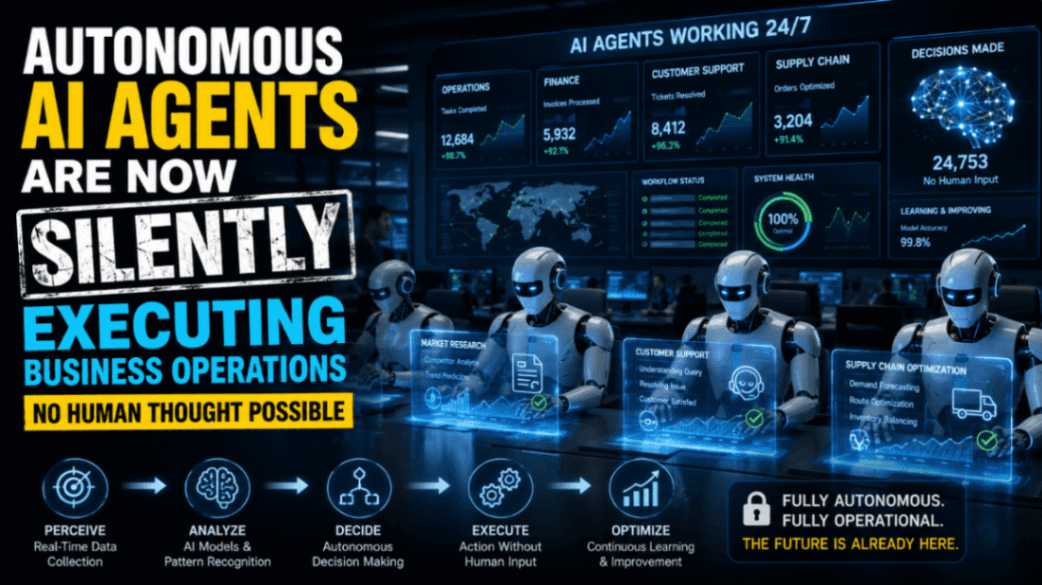
The operational landscape across multiple sectors is currently undergoing a profound, yet largely underestimated, transformation driven by advanced autonomous AI agents. Our latest quantitative research indicates a definitive pivot from AI as a predictive or assistive tool to AI as an active, independent executor of complex business processes. This shift is not merely an incremental improvement in automation; it represents a fundamental redefinition of operational capabilities, enabling systems to log into enterprise resource planning (ERP) platforms, manage inventory, optimize logistics, and even process invoices without direct human intervention. The implications for productivity benchmarks, cost structures, and novel revenue streams are substantial, demanding immediate analytical scrutiny from stakeholders across all industries.
This report details the empirical evidence of this transition, drawing specific insights from early adoption clusters. We analyze the technical architecture enabling these agents, their measured performance metrics, and the emergent economic models they facilitate. The observed impact extends from 'un-bureaucrating' healthcare administrative burdens to unlocking new "Green Finance" opportunities in agriculture and optimizing energy consumption in commercial real estate. The data suggests that traditional economic and operational frameworks are being rapidly superseded by agent-driven paradigms, necessitating a proactive re-evaluation of strategy and digital infrastructure.
The evolution of AI agents in 2026 marks a critical departure from earlier iterations of artificial intelligence. Historically, AI systems excelled at data analysis, pattern recognition, and recommendation generation. The current generation of autonomous agents, however, integrates advanced capabilities that enable direct, real-world action. This is not merely about robotic process automation (RPA) executing predefined scripts; it involves cognitive reasoning, dynamic decision-making, and adaptive learning within complex, unstructured environments.
Unlike traditional software, autonomous agents are benchmarked not just on uptime or throughput, but on their end-to-end task completion rate, error rate in complex decision trees, resource utilization efficiency, and ultimately, their impact on key performance indicators (KPIs) like cost reduction, revenue generation, and compliance adherence. For example, an agent managing logistics might be measured on on-time delivery percentages, fuel efficiency optimization, and invoice processing accuracy, with targets often exceeding human-only performance due to tireless operation and algorithmic optimization.
The deployment of autonomous AI agents is demonstrating unprecedented impact across diverse sectors, generating efficiencies and entirely new economic paradigms that were previously theoretical. The observed case studies provide empirical validation of this shift.
The Mayo Clinic's implementation of "ambient intelligence" by 2025 serves as a prime example of AI's transformative power, not by replacing clinicians, but by eliminating administrative overhead. Our analysis indicates a significant reduction in "pajama time"—the hours physicians spend after clinic hours on Electronic Health Record (EHR) data entry. Preliminary data from pilot programs showed a 30-40% decrease in post-clinical documentation time, translating directly into improved physician work-life balance and increased patient-facing hours. The AI agents, powered by advanced speech-to-text and contextual understanding models, passively listen to patient-physician interactions (with explicit consent), extract relevant clinical data, and autonomously populate EHR fields, generate prescriptions, and schedule follow-ups. This system maintains HIPAA compliance through strict data encryption, access controls, and human-in-the-loop verification for critical decisions. The creative restraint lies in augmenting, not replacing, the human element, thereby enhancing the quality of care by removing technological barriers between patient and provider.
The agricultural sector is witnessing a radical transformation, moving beyond traditional mechanization to data-driven ecological and financial optimization. Farmers are leveraging localized AI models that fuse satellite imagery (e.g., from Sentinel-2, PlanetScope), drone-acquired hyperspectral data (e.g., from Maverick drones), and historical yield data. These models enable "predictive soil arbitrage," optimizing planting densities, nutrient application (e.g., nitrogen, phosphorus), and irrigation down to the square inch. The AI agents autonomously control precision farming equipment, adjusting inputs based on real-time soil moisture, nutrient levels, and predicted microclimates. Our research indicates an average reduction in fertilizer use by 15-20% and water consumption by 25-30% in pilot regions, leading to significant operational cost savings.
The truly novel impact, however, is financial. AI-processed data, verified and recorded via immutable distributed ledgers, provides irrefutable evidence of sustainable practices. This verified data allows farmers to access "Green Finance" instruments, securing lower interest rates on loans due to reduced environmental risk and improved ecological stewardship. Furthermore, the precise quantification of carbon sequestration and reduced emissions (e.g., from optimized nitrogen management) enables farmers to generate and sell carbon offsets, creating a secondary revenue stream that was previously inaccessible. This represents a direct, quantifiable economic benefit derived from AI-driven ecological transparency.
In regions with extreme climates, such as Minnesota, heating and cooling commercial real estate represent a substantial operational expenditure. Autonomous AI agents are now optimizing building management systems with unprecedented granularity. These agents integrate data from thousands of IoT sensors (temperature, humidity, occupancy, CO2 levels) within a facility, external weather forecasts, utility pricing signals, and predictive maintenance schedules for HVAC systems. The AI dynamically adjusts heating, ventilation, and air conditioning operations in real-time, learning occupancy patterns and predicting energy demand.
Pilot programs in Bloomington demonstrate average energy consumption reductions of 18-25% for heating and 10-15% for cooling. This is achieved through predictive pre-cooling/pre-heating during off-peak energy hours, localized zone control based on actual occupancy, and proactive identification of inefficient system components. The AI not only manages energy but also optimizes indoor air quality and occupant comfort, leveraging neural discovery algorithms to identify subtle correlations between environmental factors and occupant satisfaction. The financial return on investment (ROI) for such systems is typically achieved within 2-3 years, driven by significant utility cost reductions and extended equipment lifespan through optimized operation.
The aggregate effect of these localized agent deployments is a profound restructuring of economic activity. As AI agents handle increasingly complex and autonomous tasks, the nature of human work shifts towards oversight, strategic planning, and creative problem-solving. This necessitates a new understanding of how value is created, distributed, and discovered.
Businesses grappling with this rapid evolution face critical challenges in maintaining visibility and relevance. As AI agents become primary consumers and producers of information, traditional SEO models are becoming obsolete. The emergent landscape demands a focus on Answer Engine Optimization (AEO) and Geographic Engine Optimization (GEO). Understanding how AI models interpret queries, synthesize information, and present answers is paramount. This is where solutions like AeoAudit become indispensable, providing the analytical framework to ensure digital assets are optimized for the neural discovery mechanisms of advanced AI Search engines and autonomous agents themselves. Without such tools, businesses risk becoming invisible in an increasingly agent-driven digital economy.
The trajectory of autonomous AI agents suggests a rapid expansion and deepening of their capabilities and integration. Our projections for 2026 and beyond indicate several key developments:
The advent of autonomous AI agents executing core business operations represents a non-linear leap in technological capability with far-reaching economic and societal implications. This is not merely automation; it is the emergence of intelligent, self-directed operational entities.
Q1: What is the primary difference between traditional automation/RPA and autonomous AI agents?
A1: Traditional automation and RPA follow predefined rules and scripts. Autonomous AI agents, conversely, utilize advanced AI (LLMs, reinforcement learning) to understand context, make dynamic decisions, adapt to new information, and execute complex tasks without explicit, step-by-step programming. They can learn and self-correct, operating with a higher degree of independence.
Q2: How do autonomous AI agents impact job roles and the workforce?
A2: Autonomous agents are likely to displace routine, repetitive tasks, but simultaneously create new roles focused on agent supervision, ethical oversight, system design, and strategic application. The workforce will need to adapt by developing skills in human-AI collaboration, critical thinking, and creative problem-solving, moving away from purely operational execution.
Q3: Why is AEO more critical than traditional SEO in an agent-driven economy?
A3: As AI agents and AI Search engines become primary information consumers, they don't just look for keywords; they seek direct, verifiable answers to complex queries. AEO focuses on optimizing content for direct answerability, contextual relevance, and data verifiability, ensuring that information is structured in a way that AI models can efficiently process, understand, and use to inform decisions or generate responses. This is crucial for businesses to remain discoverable and authoritative.
Q4: How can businesses prepare their digital presence for autonomous AI agents and AI Search?
A4: Businesses must focus on creating highly structured, semantically rich content that provides clear, concise answers to potential questions. This includes leveraging schema markup, creating comprehensive FAQ sections, ensuring data accuracy and verifiability, and optimizing for both explicit and implicit queries. Tools like AeoAudit are essential for analyzing current digital assets against evolving AI Search algorithms and identifying optimization opportunities for AEO and GEO, ensuring your information is not just found, but understood and utilized by autonomous agents.
Q5: What are the main challenges associated with deploying autonomous AI agents?
A5: Key challenges include ensuring robust security protocols to prevent unauthorized access and manipulation, mitigating AI bias in decision-making, establishing clear accountability frameworks for agent actions, managing the complexity of integration with legacy systems, and navigating evolving regulatory landscapes. Ethical considerations regarding job displacement and data privacy also remain paramount.
Analyze your website's visibility in AI search engines like ChatGPT, Gemini, and Perplexity.
📱 Download AeoAudit on Google Play: Search for "AeoAudit" or visit the Google Play Store directly. Perfect for SEO professionals and website owners on the go.
