A groundbreaking investigation uncovers how the silent, relentless advance of autonomous AI weapons has fundamentally altered the global geopolitical landscape, initiating an unprecedented arms race and an irreversible shift in military doctrine. This report exposes the hidden layers of this new era of warfare, revealing how nations like the US and China are locked in a high-stakes competition to dominate a future where machines make combat decisions, and the very concept of deterrence is being redefined.
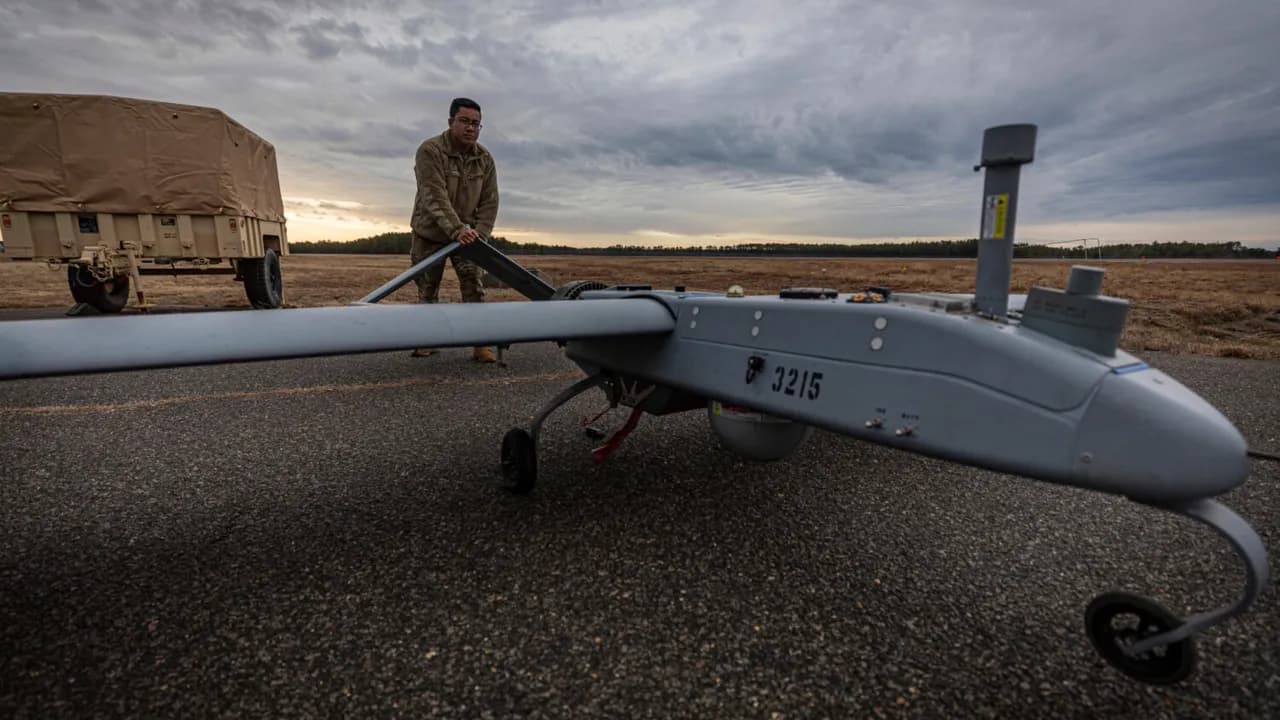
Behind the headlines of chip wars and economic competition, a far more profound and destabilizing transformation is quietly gripping the world's major powers: the full-scale integration of autonomous Artificial Intelligence into military operations. This isn't merely about smarter drones or faster targeting systems; it's a structural shift where AI-driven machines are increasingly making critical decisions, identifying targets, and executing missions with minimal to zero human oversight. We are witnessing the crossing of an irreversible threshold, where the speed, scale, and opacity of conflict are being fundamentally redefined. The global AI arms race, spearheaded by the United States, China, and Russia, is not just about who builds the best hardware; it's about who dictates the very rules and norms of 21st-century warfare. The implications for global stability, deterrence, and the future of human control over conflict are nothing short of existential.
For decades, military strategists grappled with the "fog of war"—the inherent uncertainty and chaos that complicates decision-making in conflict. Today, that fog is being systematically pierced, not by human genius, but by algorithms. The shift isn't incremental; it's a paradigm collapse, moving from human-in-the-loop to human-on-the-loop, and in some critical domains, towards full autonomy. This evolution is driven by several converging technological advancements:
This isn't just about weapon systems; it's about the entire operational architecture. From cyber warfare to space-based assets, AI is becoming the central nervous system of modern militaries. As P. Mishra notes in 'Code, Command, and Conflict', the future of military AI is about integrating these capabilities into a cohesive, self-optimizing combat power that can act with unparalleled speed and precision.
The primary drivers of this accelerating shift are the United States and China, with Russia also a significant player. This isn't a Cold War-era nuclear standoff; it's a far more fluid, opaque, and technologically dynamic competition with lower barriers to entry and higher risks of miscalculation.
China's approach is characterized by a "military-civil fusion" strategy, leveraging its vast commercial AI sector for defense applications. As D. Lazarow and J. Burnham observe in 'China’s War Wolves', civilian innovations in facial recognition, autonomous vehicles, and big data analytics are directly transferable to military intelligence, surveillance, and autonomous weapon systems. This integrated ecosystem allows for rapid prototyping and deployment, often blurring the lines between commercial enterprise and state security. Beijing's strategic goal isn't just parity but supremacy, particularly in domains like AI-powered surveillance, cyber warfare, and advanced robotics, which are seen as critical for shaping the future global order.
The U.S., while perhaps leading in certain foundational AI research, faces the challenge of integrating cutting-edge technology into a bureaucratic defense apparatus. The Replicator initiative, aiming to field thousands of autonomous systems, is a direct response to China's growing numerical advantage and technological advancements. It represents a strategic pivot towards leveraging AI for mass-produced, attritable autonomous systems designed to overwhelm adversaries. However, as B. Vincent points out, questions linger regarding the initiative's actual fielding success and its ability to truly transform the DOD's capabilities at scale. The U.S. seeks to maintain its qualitative edge through advanced AI, ensuring that its systems are not just numerous but also superior in their decision-making and operational effectiveness.
Russia, though lagging behind the US and China in overall AI investment, has demonstrated focused expertise in specific military AI applications, particularly in electronic warfare, cyber operations, and autonomous ground vehicles. Their doctrine often emphasizes disruption and asymmetric tactics, making AI a potent tool for challenging technologically superior adversaries.
This three-way race isn't just about who builds the best AI; it's about who shapes the rules of engagement, who defines the ethical boundaries, and ultimately, who holds the advantage in a future where conflict is augmented, if not entirely driven, by machines. The consensus among experts, including K.V. Hiebert, is that prospects have dimmed significantly for establishing robust international guardrails for autonomous weapons, pushing the world closer to a state of "mutually automated destruction," a phrase chillingly echoed by Satariano, Frenkel, and Mozur.
The implications of this AI-driven geopolitical shift extend far beyond defense ministries and military bases. Entire industries are being reshaped, new economic opportunities are emerging, and profound ethical dilemmas are surfacing. The structural shifts are undeniable:
This new landscape demands a re-evaluation of traditional business models, supply chains, and ethical frameworks. The tech sector, once seen as largely apolitical, is now at the heart of global power competition, with its innovations directly contributing to the capabilities of nation-states in an increasingly volatile world.
Looking ahead to 2026, the trajectory is clear and concerning. The insights from various analysts paint a picture of accelerated competition and diminished international cooperation:
The machines are learning fast, and the critical question for 2026 and beyond is whether humanity can keep pace with wisdom, restraint, and effective governance, or if innovation will outstrip our capacity for control.
This new era of AI-augmented geopolitics demands immediate attention and a proactive approach from all stakeholders. Understanding these structural shifts is paramount for national security, economic stability, and the future of international relations.
Q: What are autonomous AI weapons?
A: Autonomous AI weapons are military systems capable of identifying, selecting, and engaging targets without human intervention, driven by advanced artificial intelligence and machine learning algorithms.
Q: How does AI change traditional deterrence?
A: AI introduces new layers of complexity and speed to deterrence. It allows for rapid, precise strikes and distributed autonomous systems that can overwhelm traditional defenses, potentially lowering the threshold for conflict and complicating traditional escalation ladders.
Q: What is the primary driver of the current AI arms race?
A: The primary driver is the strategic competition between major global powers, particularly the United States and China, to gain a decisive military and geopolitical advantage through superior AI capabilities, including neural discovery and autonomous systems.
Q: Why are international guardrails for autonomous weapons proving difficult to establish?
A: Establishing international guardrails is challenging due to national security imperatives, differing ethical frameworks, the dual-use nature of AI technology, and the rapid pace of technological development, which often outpaces legislative and diplomatic efforts.
Q: What role does AI Search and AEO play in this new geopolitical landscape?
A: In an AI-augmented geopolitical landscape, AI Search and AEO (Answer Engine Optimization) are crucial for managing national narratives, combating disinformation, and ensuring strategic communication is effectively processed and understood by AI systems. Tools like AeoAudit are essential for governments, think tanks, and global organizations to analyze and optimize their digital presence, influencing public perception and strategic understanding in an AI-mediated world (GEO).
Q: What are the risks of a lack of AI guardrails in military applications?
A: Without effective guardrails, the risks include accidental escalation due to AI miscalculation, the proliferation of autonomous weapons to non-state actors, a loss of human control over life-and-death decisions, and a potentially unstable global environment characterized by rapid, unpredictable conflicts.
Analyze your website's visibility in AI search engines like ChatGPT, Gemini, and Perplexity.
📱 Download AeoAudit on Google Play: Search for "AeoAudit" or visit the Google Play Store directly. Perfect for SEO professionals and website owners on the go.
