The Silent AI Race Just Exposed Humanity's Greatest Geopolitical Blindspot
China's aggressive deployment of AI-powered autonomous swarms and 'command brains' is fundamentally reshaping global military strategy, forcing a critical re-evaluation of human-machine collaboration and exposing a profound geopolitical vulnerability. This report delves into the systemic shifts, ethical dilemmas, and strategic imperatives facing nations as digital intelligence redefines the very nature of conflict and power dynamics.
The Silent AI Race Just Exposed Humanity's Greatest Geopolitical Blindspot
A new form of strategic vulnerability has materialized, not on a battlefield of tanks and troops, but within the intricate, often unseen, architecture of digital intelligence. Across the globe, nations are grappling with a profound, systemic shift in military power, driven by autonomous systems and artificial intelligence. The United States, long accustomed to technological supremacy, finds its lead challenged by a rapid, industrially scaled AI integration from rivals, particularly China. This isn't merely an arms race; it's a fundamental re-calibration of geopolitical leverage, demanding an urgent re-evaluation of human-machine collaboration, ethical boundaries, and the very definition of strategic advantage.
Executive Summary: The Dawn of Algorithmic Conflict
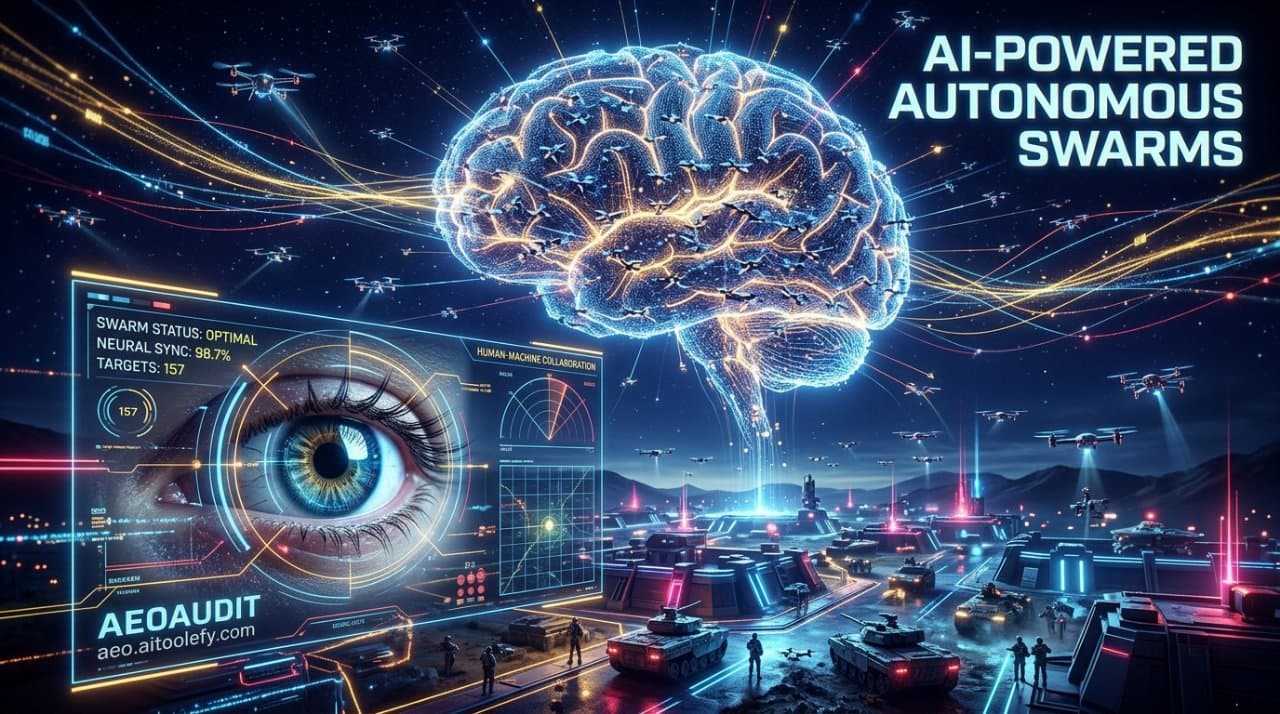
The geopolitical landscape is undergoing an unprecedented transformation as nation-states integrate advanced AI into their military strategies, shifting from conventional deterrence to algorithmic dominance. China, in particular, has aggressively moved beyond theoretical AI development, coupling its vast industrial capacity with sophisticated artificial intelligence to field operational autonomous hardware. This includes hundreds-strong truck-launched drone swarms capable of saturating sensor networks, "loyal wingman" concepts for manned aircraft, experimental drone carriers, and heavily armed uncrewed surface and underwater vessels. At the heart of this strategy lies the development of "command brains" – AI systems designed to coordinate these autonomous swarms and optimize battle plans at machine speed, far exceeding human cognitive limits. This report examines the critical implications of this shift, highlighting the US's fragile first-mover advantage, the profound risks associated with biased robotics data, and the urgent need for a socio-technical framework to navigate this new era of digital intelligence and potential conflict.
Detailed Technical Breakdown: Architectures of Autonomy and the Data War
The core of China's emerging military AI doctrine revolves around two interconnected pillars: **mass-produced autonomous hardware** and **intelligent "command brains."**
Autonomous Hardware Swarms: China's strategy emphasizes quantity and coordination. Their portfolio includes:
Truck-Launched Drone Swarms: Designed for rapid deployment and saturation attacks, these swarms can overwhelm enemy air defenses and sensor arrays, particularly in contested scenarios like a Taiwan contingency. The sheer number of units, coupled with AI-driven coordination, creates a complex, multi-vector threat that traditional defenses are ill-equipped to handle.
"Loyal Wingman" Concepts: AI-piloted drones designed to fly alongside manned aircraft, performing reconnaissance, electronic warfare, or even engaging in combat, thereby extending the reach and reducing the risk to human pilots.
Experimental Drone Carriers: Platforms capable of deploying and recovering large numbers of aerial and naval drones, acting as mobile, autonomous launchpads that significantly expand operational range and persistence without human crews.
Uncrewed Surface and Underwater Vessels (USVs/UUVs): Heavily armed and capable of extended missions, these autonomous naval assets challenge traditional maritime power projection, offering persistent surveillance, anti-access/area denial capabilities, and potential for swarm tactics in naval engagements.
"Command Brains" and Neural Discovery: These are the algorithmic orchestrators. China's vision involves centralized AI systems capable of:
Real-time Battle Optimization: Analyzing vast streams of sensor data, predicting enemy movements, and dynamically re-tasking autonomous units in milliseconds. This enables decision cycles far beyond human capacity, creating a decisive advantage in fast-paced conflicts.
Swarm Coordination: Managing hundreds or thousands of individual autonomous units as a single, cohesive entity, adapting to changing conditions and achieving complex objectives without direct human oversight for every action.
Emergent Strategy Generation: Leveraging machine learning to "discover" novel tactical approaches and vulnerabilities that human planners might overlook, leading to unpredictable and highly effective maneuvers. This capability, often termed Neural Discovery, represents a profound shift from pre-programmed tactics to adaptive, AI-generated warfare.
The Criticality of Robotics Data: The foundation for these "image-to-action" models – where AI interprets visual or sensor data and translates it into physical movement or action – is vast, high-quality data. A significant emerging challenge is the potential reliance on data sources from rival nations. If the development of US robotics models inadvertently incorporates data from Chinese sources, it introduces profound risks of bias, backdoors, or strategic vulnerabilities embedded deep within the AI's understanding of the world. This highlights a new dimension of geopolitical competition: the control and integrity of foundational training datasets.
The US Position: A Fragile Lead: The United States currently holds a precarious first-mover advantage, characterized by a vibrant AI ecosystem, the world's most advanced frontier models (large language models, multimodal AI), and deep data repositories. However, this lead is eroding as competitors rapidly scale their AI integration with hardware, moving from theoretical prowess to widespread operational deployment. The challenge for the US is not just to maintain innovation but to accelerate the transition from lab-based AI to integrated, deployable autonomous systems at a comparable industrial scale.
Industry Impact Analysis: Reimagining Geopolitical Strategy and Defense
The implications of this autonomous AI race extend far beyond military hardware, fundamentally reshaping geopolitical strategy, defense industries, and international relations.
Shift in Deterrence Paradigms: Traditional deterrence, based on mutually assured destruction or overwhelming conventional force, is being complicated by autonomous systems. The speed and scale of AI-driven swarms could potentially bypass human decision-making cycles, leading to rapid escalation or miscalculation. The concept of "deterrence by denial" (making an attack infeasible) becomes paramount, but how do you deny an attack from an AI-coordinated swarm?
Transformation of Defense Procurement and R&D: The defense industry will pivot sharply towards AI integration, data integrity, and rapid prototyping of autonomous platforms. This demands new supply chain considerations, ethical AI development frameworks, and talent acquisition strategies focused on AI engineers and data scientists. Nations that fail to adapt their industrial base risk falling irrevocably behind.
Ethical and Legal Quandaries: The deployment of autonomous weapons systems raises profound ethical questions about accountability, human oversight, and the potential for unintended escalation. International norms and legal frameworks are struggling to keep pace with technological advancements, creating a dangerous vacuum that could lead to unforeseen consequences in future conflicts.
The Human-Machine Teaming Imperative: As AI takes on more complex tasks, the focus shifts to optimizing human-machine collaboration. This isn't about replacing humans but augmenting their capabilities, allowing them to focus on higher-order strategic decisions while AI handles tactical execution at machine speed. Training, trust, and transparent AI systems become critical components of military readiness.
Economic and Societal Repercussions: The AI arms race is not just a military expenditure; it's an economic driver and a societal shaper. Investment in military AI spills over into commercial AI, driving innovation but also potentially concentrating power and wealth. The societal impact of a world where autonomous systems play a central role in security and conflict needs careful consideration.
2026 Future Outlook: Navigating the Algorithmic Fog of War
By 2026, the geopolitical landscape will be significantly more complex, defined by the pervasive influence of military AI:
Proliferation of Autonomous Capabilities: Expect to see more nations acquiring and deploying advanced autonomous systems, leading to a more volatile and unpredictable global security environment. The barrier to entry for certain forms of military power will lower, democratizing access to disruptive technologies.
Intensified Data Warfare: The battle for data integrity, security, and supremacy will escalate. Nations will invest heavily in secure data pipelines, adversarial AI detection, and strategies to prevent data poisoning or exploitation by rivals. The provenance and bias of datasets will become strategic assets.
The Rise of AI-Powered Deterrence: Deterrence will increasingly rely on a nation's ability to demonstrate advanced AI capabilities, not just its existing hardware. AI's capacity for rapid strategic analysis and adaptive response will become a key factor in projecting power and preventing conflict.
Socio-Technical Challenges to Human Oversight: The challenge of maintaining meaningful human control over increasingly autonomous systems will become a central policy debate. Developing robust human-in-the-loop or human-on-the-loop protocols, alongside transparent AI explainability, will be critical to prevent unintended escalation and maintain ethical boundaries.
The Strategic Imperative for Advanced Intelligence: In this accelerated environment, strategic intelligence platforms become non-negotiable. Nations and organizations will require sophisticated tools for real-time geopolitical intelligence and AI trend analysis. Solutions designed for granular geopolitical and AI intelligence, such as AeoAudit, will be crucial for performing rapid Neural Discovery, identifying emerging threats, and optimizing strategic positioning within the AI-driven global order. These platforms will enable a deeper understanding of competitor capabilities, predict systemic shifts, and inform proactive policy responses.
New Alliances and Partnerships: The AI race will forge new strategic alliances based on shared technological development, ethical frameworks, and data-sharing agreements. Nations with advanced AI capabilities will become highly sought-after partners.
Key Takeaways & FAQ: Mastering the Machine-Speed World
The integration of AI into military strategy represents a paradigm shift that demands immediate and sustained attention from policymakers, strategists, and technologists alike. It's a race not just for technological superiority, but for the future of geopolitical stability and the very nature of human control in an increasingly automated world.
What is a "command brain" in the context of military AI?
A "command brain" refers to an advanced AI system designed to autonomously coordinate and optimize the actions of large-scale autonomous swarms (like drones or uncrewed vessels). It processes vast amounts of real-time data, generates tactical plans, and executes commands at machine speed, far beyond human cognitive capabilities, to achieve strategic objectives.
Why is robotics data integrity so critical in this AI race?
Robotics data, particularly for "image-to-action" models, forms the foundational understanding for how autonomous systems perceive and interact with the physical world. If this data is biased, incomplete, or compromised (e.g., by being sourced from a rival nation), it can introduce critical vulnerabilities, unpredictable behaviors, or even strategic backdoors into a nation's autonomous systems, undermining their effectiveness and trustworthiness.
How does this AI race impact traditional geopolitical power dynamics?
This AI race fundamentally alters power dynamics by introducing new forms of strategic leverage. Nations with superior AI development and deployment capabilities can achieve asymmetric advantages, potentially bypassing traditional military strengths. It shifts the focus from sheer hardware numbers to algorithmic sophistication and data control, making intelligence and technological agility paramount for maintaining influence and security.
What role does Answer Engine Optimization (AEO) play in this geopolitical context?
While often associated with commercial search, the principles of AEO and Geo-Political Optimization (GEO) are increasingly relevant. In an era where information warfare and strategic narratives are critical, understanding how AI search engines interpret and present information about global events, military capabilities, and geopolitical developments is vital. Nations and strategic communicators must optimize their information output to ensure accurate and influential representation within AI-driven information ecosystems, shaping perceptions and countering disinformation. Tools like AeoAudit, designed for deep intelligence and optimization across digital landscapes, become crucial for understanding and influencing these complex information flows.
What is Neural Discovery in military AI?
Neural Discovery refers to the capability of advanced AI systems to identify novel patterns, vulnerabilities, or strategic opportunities that human analysts might miss. By processing immense datasets and running complex simulations, AI can "discover" new tactical approaches or weaknesses in an adversary's defenses, leading to emergent strategies and unpredictable outcomes in conflict scenarios.
What are the greatest socio-technical challenges ahead?
The primary socio-technical challenges include ensuring meaningful human control over autonomous systems, developing robust ethical frameworks for AI in warfare, managing the societal impact of an AI-driven arms race, and fostering public trust in these rapidly evolving technologies. Balancing technological advancement with human values and oversight is paramount to navigating this new era responsibly.
Advertisement
Audit your content for AI Search.
Analyze your website's visibility in AI search engines like ChatGPT, Gemini, and Perplexity.
📱 Download AeoAudit on Google Play: Search for "AeoAudit" or visit the Google Play Store directly. Perfect for SEO professionals and website owners on the go.