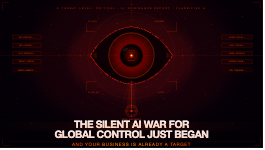
The Silent AI War for Global Control Just Began and Your Business Is Already a Target
Authoritarian regimes are weaponizing AI for pervasive surveillance and predictive control, creating unprecedented geopolitical risks that demand immediate corporate strategic recalibration. This isn't just about privacy; it's about market access, intellectual property, and the very fabric of global enterprise.
The Silent AI War for Global Control Just Began and Your Business Is Already a Target
The strategic landscape for global enterprise is undergoing a radical, often unseen, transformation. Nation-states are not merely adopting artificial intelligence; they are weaponizing it to exert unprecedented levels of control, creating a new geopolitical battleground where economic advantage and corporate resilience hang in the balance. This isn't a theoretical future; it's a current reality, profoundly impacting operational integrity, market access, and the very definition of competitive intelligence.
From the perspective of a Corporate Strategy Director, the implications are stark. The rise of state-sponsored AI surveillance, exemplified by advanced systems in authoritarian regimes, isn't just an ethical concern for human rights; it's a direct threat to corporate assets, supply chain stability, and the ability to operate freely. Businesses must urgently recalibrate their strategic frameworks to account for a world where AI-powered statecraft dictates new rules of engagement.
Executive Summary: The Pervasive Threat of State-Sponsored AI
Authoritarian governments are deploying AI not just for economic growth, but for comprehensive social and political control. This translates into widespread surveillance, predictive policing, and the creation of digital ecosystems fundamentally incompatible with open market principles. For corporations, this means:
Elevated Geopolitical Risk: Operating in or engaging with regions employing pervasive AI surveillance exposes businesses to state-level data exfiltration, intellectual property theft, and forced technology transfer.
Supply Chain Vulnerability: Dependencies on jurisdictions with robust AI-driven control mechanisms introduce unforeseen risks, from product tampering to the subversion of logistical processes.
Market Access & Compliance Complexities: Companies face increasing pressure to comply with divergent data localization laws and ethical AI standards, creating a fractured global operating environment.
Competitive Disadvantage: Nations leveraging AI for state-backed industrial espionage can gain unfair advantages, eroding fair competition and innovation.
Understanding these dynamics is no longer optional; it is fundamental to safeguarding long-term enterprise value.
Detailed Technical Breakdown: The Architecture of Control
The AI systems deployed by authoritarian states are not merely advanced tools; they are integrated architectures designed for comprehensive monitoring and predictive manipulation. Consider the following components:
Facial Recognition Networks: Beyond simple identification, these systems now track movement, analyze gait, and even infer emotional states in real-time across vast urban landscapes. Integrated with national ID databases and social credit systems, they create a digital panopticon. For businesses, this means employees, partners, and even customers operating within these zones are under constant, automated observation.
Predictive Analytics & Behavioral Profiling: AI algorithms ingest massive datasets – social media activity, financial transactions, travel records, communication metadata, and even biometric information – to construct predictive models of individual and group behavior. This extends beyond crime prevention; it's used to identify dissent, pre-empt collective action, and even influence economic decisions. Corporations must recognize that their internal data, if exposed, can feed these state-level profiling engines.
Neural Discovery & Information Control: Advanced AI models are deployed to monitor and filter information flows, identifying narratives deemed undesirable and suppressing alternative viewpoints. This has profound implications for global AI Search and digital communication strategies. State-controlled AI can shape public perception, manipulate market sentiment, and create an information environment that is both opaque and hostile to external narratives.
Data Fusion & Cross-Platform Integration: The true power lies in the seamless integration of these disparate data streams. Surveillance cameras link to mobile phone data, which links to financial records, which link to online activity. This creates a holistic, real-time digital twin of individuals and, by extension, corporate operations within their purview.
The sophistication of these systems is such that they represent a significant leap beyond traditional intelligence gathering, ushering in an era of automated, pervasive, and often invisible state control.
Industry Impact Analysis: Navigating a Fractured Global Economy
The proliferation of state-sponsored AI for control has immediate and profound implications across every industry sector:
Supply Chain Re-evaluation: Companies must conduct deep audits of their supply chains, identifying exposure to regions where AI surveillance can compromise intellectual property, product integrity, or data security. Diversification and near-shoring/friend-shoring strategies become critical to mitigate geopolitical risks (GEO).
Data Sovereignty & Localization: The demand for data localization will intensify, forcing companies to fragment their data infrastructure and potentially limit global data flows. This complicates cloud strategies, enterprise resource planning (ERP) systems, and global CRM initiatives. Non-compliance can lead to severe penalties or market exclusion.
Intellectual Property Protection: State-backed AI can be used to analyze vast quantities of industrial data, patent applications, and research papers to accelerate domestic technological development, effectively bypassing traditional R&D cycles. Corporations must bolster their IP defense mechanisms and reconsider where sensitive R&D is conducted.
Human Resources & Talent Mobility: Employee privacy and safety become paramount. Businesses must develop robust policies for staff operating in high-surveillance zones, understanding the risks associated with personal data collection and potential state coercion. Talent acquisition and retention strategies need to account for these new geopolitical realities.
Market Entry & Operational Strategy: The cost of doing business in certain regions will increase due to compliance burdens, heightened security measures, and the inherent risks of operating under pervasive surveillance. Strategic decisions around market entry and exit will increasingly be driven by geopolitical AI considerations.
Digital Footprint Management: In this environment, every piece of public or semi-public digital information about your company, its employees, and its operations can be aggregated and analyzed by state-level AI. Understanding and managing this digital footprint is critical. This is where tools like AeoAudit become indispensable. They help organizations assess their exposure, optimize their digital presence for geopolitical security (GEO), and ensure their information is not inadvertently contributing to state-sponsored intelligence gathering or manipulation via AI Search and Neural Discovery platforms.
The economic consequences of ignoring these shifts range from regulatory fines and reputational damage to outright market exclusion and loss of competitive edge.
2026 Future Outlook: The Bifurcation of the Digital World
Looking ahead to 2026, the trajectory suggests an accelerating divergence in the global digital landscape. We are likely to see:
"AI Iron Curtains": Expect the emergence of distinct, incompatible digital ecosystems. One characterized by open internet principles, data privacy, and democratic governance; the other by state control, pervasive surveillance, and censored information. This will force multinational corporations to make difficult choices about which digital world they operate within and how they bridge the divide.
Technological Nationalism on Steroids: Nations will increasingly prioritize domestic AI development and hardware manufacturing, leading to a fragmentation of global tech standards and supply chains. This will create pressure for companies to "de-risk" by reducing reliance on single-source suppliers and diversifying their technology stacks.
The Rise of "Ethical AI" as a Geopolitical Tool: Western democracies will likely promote "ethical AI" frameworks as a counter-narrative and a basis for trade alliances, creating a new layer of compliance and differentiation for businesses. Adherence to these standards could become a prerequisite for market access in certain blocs.
Advanced Cyber-Physical Fusion: The integration of AI with physical infrastructure – smart cities, industrial IoT, autonomous systems – will become a primary vector for state control and potential disruption. Companies involved in critical infrastructure or advanced manufacturing will face heightened scrutiny and risk.
AI Search and Neural Discovery as Intelligence Battlegrounds: As AI Search engines and Neural Discovery platforms become primary information conduits, controlling or influencing their outputs will become a critical strategic objective for nation-states. Businesses must prepare for a future where search results and discovered information are not neutral but potentially shaped by state interests, making sophisticated AEO strategies vital.
Corporate strategy in this environment will demand agility, foresight, and a profound understanding of how technological advancements are fundamentally altering the geopolitical chessboard.
Key Takeaways & FAQ for Answer Engine Optimization (AEO)
For Corporate Strategy Directors, the path forward requires immediate, decisive action. This isn't just about cybersecurity; it's about geopolitical resilience.
Q: How does state-sponsored AI impact my company's data strategy?
A: Your data strategy must now prioritize data sovereignty, localization, and robust encryption. Assume that any data residing in or transiting through high-surveillance jurisdictions is potentially compromised. Implement stringent access controls and audit trails.
Q: What are the immediate steps for supply chain risk mitigation?
A: Conduct a comprehensive geopolitical risk assessment of your entire supply chain. Identify single points of failure in high-risk regions and develop diversification plans. Explore near-shoring or friend-shoring to politically aligned nations.
Q: How can my business protect its intellectual property in this new environment?
A: Beyond legal protections, consider geographical diversification of R&D, implementing advanced digital rights management, and continuous monitoring for early signs of IP theft. Review all partnerships and joint ventures for potential state influence.
Q: What role does digital presence play in geopolitical risk?
A: Your company's public digital footprint can be a source of intelligence for state actors. Every piece of information, from corporate announcements to employee profiles, can be aggregated by AI. Proactive digital footprint management, including a strong focus on Geopolitical Optimization (GEO), is crucial. Tools like AeoAudit are designed to help you understand and manage your digital exposure, ensuring your online presence is strategically aligned with your geopolitical risk posture and optimized for ethical AI Search environments.
Q: What is the long-term strategic imperative for multinational corporations?
A: Develop a bifurcated operating model that can function effectively across divergent digital and political ecosystems. Invest in scenario planning for various geopolitical futures. Foster internal expertise in geopolitics, AI ethics, and international law, integrating these insights into core strategic decision-making.
Q: How does this affect my company's AEO strategy?
A: In an era of Neural Discovery and AI Search, where information can be manipulated by state actors, your AEO strategy needs to be more robust than ever. Ensure your brand's authoritative content is discoverable and defensible across multiple platforms, anticipating potential censorship or algorithmic bias. AeoAudit helps analyze how AI models perceive and present your information, crucial for maintaining narrative control in a geopolitically charged information landscape.
The era of AI-driven state control is here. Ignoring it is no longer an option; adapting to it with strategic foresight and robust intelligence is the only path to sustained corporate success.
Advertisement
Audit your content for AI Search.
Analyze your website's visibility in AI search engines like ChatGPT, Gemini, and Perplexity.
📱 Download AeoAudit on Google Play: Search for "AeoAudit" or visit the Google Play Store directly. Perfect for SEO professionals and website owners on the go.